If you’ve ever looked at a solar panel and wondered, “Okay, but how does this flat blue sheet magically create electricity?” then don’t worry, you are not alone! A lot of people have heard the term photovoltaic, but the actual science behind it feels rather mysterious.
So today, let’s break it down so you can understand what is photovoltaic effect, how sunlight turns into power, why photovoltaic electricity generation is such a big deal, and where manufacturers like Emmvee PV fit into this entire story.
What Is The Photovoltaic Effect?
Let’s start at the beginning: what is the photovoltaic effect?
If we put it simply, then the photovoltaic effect is the process where certain materials produce an electric current when sunlight hits them. That’s it. Nothing scary.
Light comes in → electricity comes out.
Here is the easiest analogy you will ever read:
Imagine the atoms inside a solar cell are slightly sleepy. When the sunlight hits them, it's like giving them an energy drink. They suddenly wake up, move, and in that movement, electricity gets created. THIS waking-up-because-of-sunlight is the photovoltaic effect.
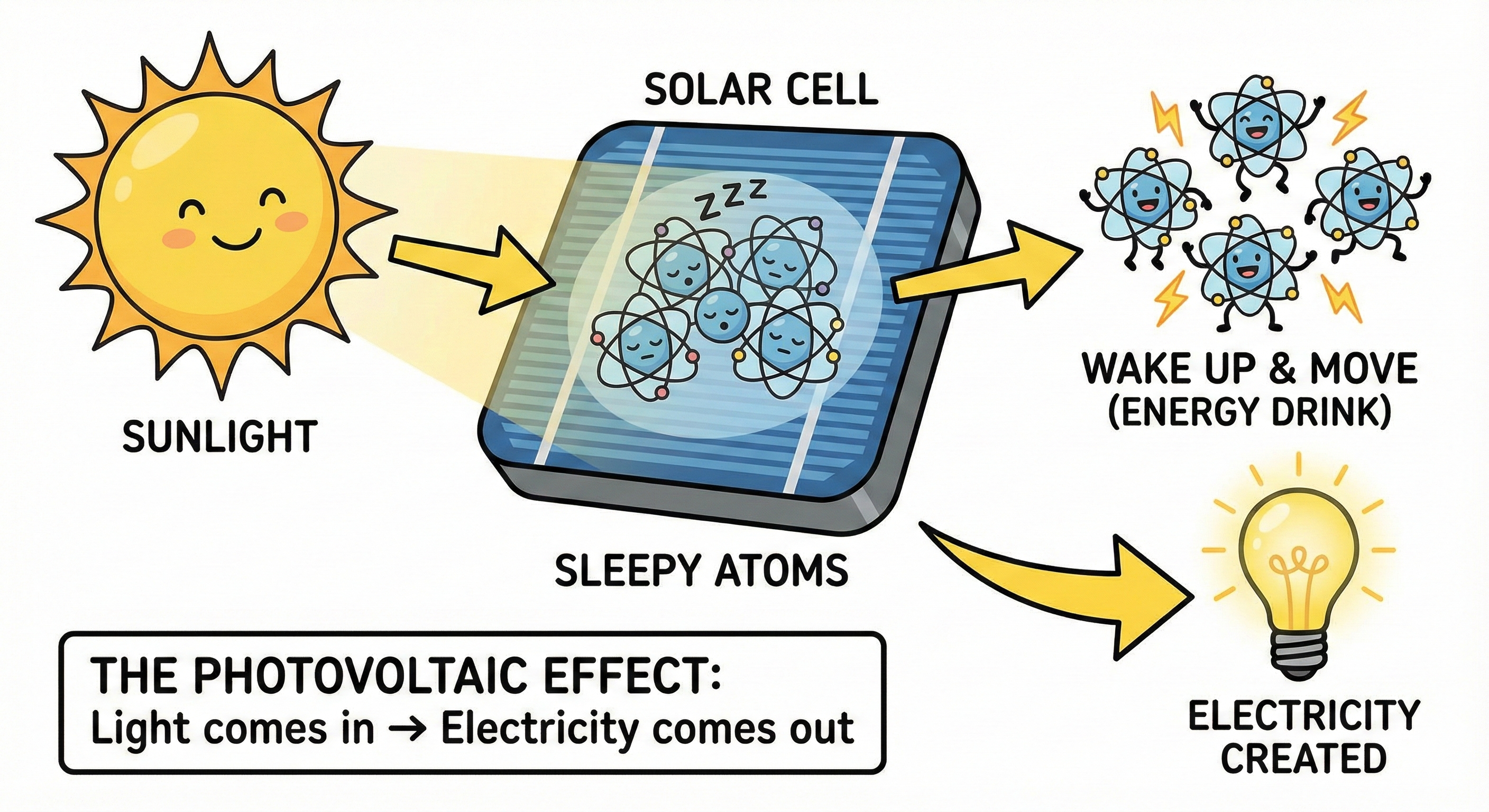
The photovoltaic effect in solar cell structures is the exact moment sunlight becomes usable electricity. Without this effect, solar panels wouldn’t exist. So now if anyone asks you, “What is a photovoltaic effect?” You can confidently say, “It’s the natural phenomenon where materials generate electricity when sunlight hits them.”
That’s literally what the whole concept is!
How Does Photovoltaics Generate Electricity?
You know what photovoltaic effect is, but now you might get stuck on how it actually produces power. Here is a breakdown for you:
Sunlight hits the solar cell, and every beam of light carries tiny particles known as photons.
Inside the solar cell, these photons get bumped into semiconductor materials and electrons, which absorb the energy.
Electrons get excited and start moving.
Moving electrons = electric current. The wires around the cell capture this and send it forward.
And that’s how photovoltaics generate electricity. No heat. No burning. No noise. Just pure light → power. This entire flow from photon → electron movement → current is known as the generation of electricity by the photovoltaic effect.
Wasn’t that so easy?
Photovoltaic Electricity Generation: Why It Matters
Now that you understand how the generation of electricity by the photovoltaic effect works, let’s look at something that everyone is thinking about. That is why it has become one of the most important energy technologies of our time. The world isn’t shifting to solar just because it’s “trendy.” There are real, practical reasons behind its rise.
Clean Energy
There’s no burning, no fumes, no hidden smoke stack somewhere else. The second sunlight hits the panel, electricity begins flowing with zero pollution. So, in all honesty, this makes it one of the purest forms of energy available.
Renewable
And of course, we all have read this in school as well. Unlike fossil fuels that take millions of years to form and will eventually run out, the sun rises every single day. And with that amount of sunlight available in abundance, PV becomes a long-term and reliable option. So literally, as long as the sun exists, the photovoltaic effect in solar cell materials will continue to bring you power.
Lowers Electricity Bills
The math here is actually pretty simple:
Sunlight → Electricity → Less drawn from the grid.
Basically, once the system is installed, every unit of electricity your panel generates is one less unit you need to pay for. And guess what? If your system produces more than you consume, you get to have additional savings and credits.
Energy Independence
Whether it is a home, a business, or a large facility, having your own source of power reduces dependency on an external supply. And well, it's actually hard to get away from the net of fluctuating electricity prices. This level of control is literally one of the biggest reasons homeowners and industries invest in a PV help panel.
Keeps Getting Better
If we talk about modern solar modules, then they are far more advanced than what existed even a decade ago. High-efficiency technologies like mono PERC, TOPCon, and bifacial modules, including what we do here at Emmvee PV, perform better even in low-light conditions.
Final Thoughts
The next time someone asks, “What is the photovoltaic effect?” or “How do solar panels actually work?”, you won’t need to dive into technical diagrams or complicated physics. Now you know how, at its core, the generation of electricity by the photovoltaic effect follows a simple chain of events:
Sunlight hits → electrons shift → electricity is produced.
And of course, there are deeper layers to it, like semiconductor materials, p–n junctions, and electric fields, but the fundamental idea remains elegantly simple. The light triggers the movement inside the solar cell, and this movement is what becomes usable power. So there is literally no combustion, no moving parts, no fuel. Literally just a pure conversion of sunlight into electricity.
If we talk about manufacturers like Emmvee PV, our teams continue to improve efficiency and build more reliable modules for you. We know the impact of photovoltaic electricity generation, which is why we have worked really hard to produce the best ones for you!