There is no doubt that solar technology is changing incredibly fast. Every few years, you hear that some “new” solar cell type is breaking efficiency records or promising better performance. And right now, the spotlight is on N-type solar panels. And well, we are sure if you’ve been browsing solar options, you’ve probably come across the term again and again.
But what does it really mean?
Are N-type panels genuinely better, or is it just another industry buzzword?
And most importantly: should you even care?
That is exactly what this article breaks down for you. So no heavy technical jargon, but just a smooth conversation on what are N-type solar panels, how N-type solar modules actually work, and why so many manufacturers are moving toward them as the next big solar panel technology advancements.
Without any further ado, let’s talk!
What Are N-Type Solar Panels?
Let’s start with answering the basic question, that is: What are N-Type solar panels?
If we explain it in most simplest words, they are solar panels built using solar cells that are doped with phosphorus, which gives them a negative (N-type) charge. That’s it. That is one small change in the type of charge. This is all that makes a surprisingly huge difference in how efficiently the solar cell works.
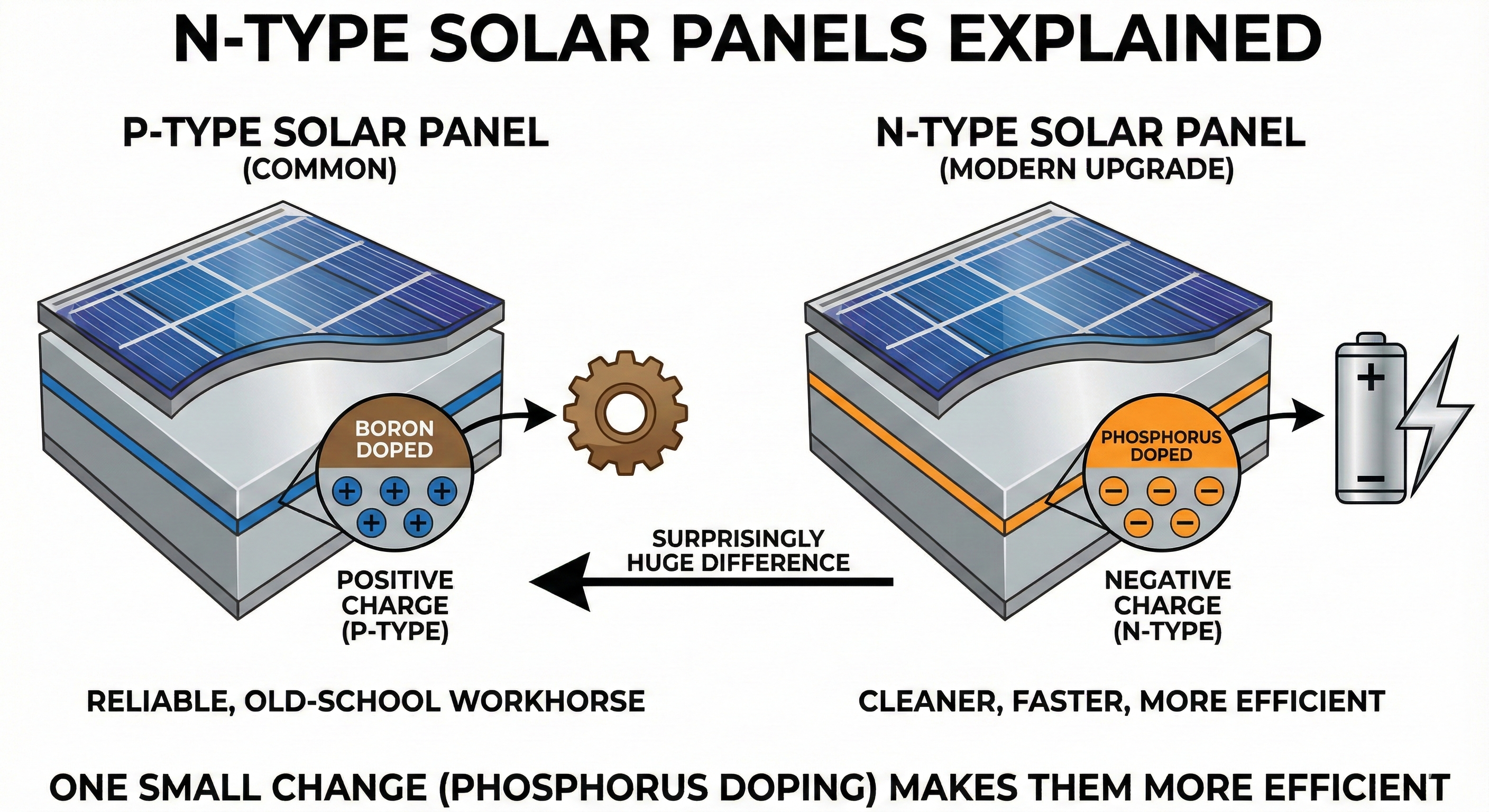
For example, if P-type panels (the older and more common ones) are like the reliable, old-school workhorse, N-type solar modules are like the upgraded, modern version. So it's cleaner, faster, and needless to say, more efficient.
And here is the easiest way to imagine it:
P-type cells are made by adding boron, → gives a positive charge → but boron reacts with oxygen and causes degradation over time.
N-type cells are made by adding phosphorus, → gives a negative charge → and is far more stable, meaning the panel holds its performance for longer.
That’s why you’ll see people saying N-type is the future. Because structurally, it simply has fewer weaknesses. Now, if you’re thinking, “Okay, but is that all?”
Well, not quite.
There’s more going on inside an N-type cell, and it’s actually really interesting. Let’s dive into that!
How Do N-Type Solar Modules Work?
Let’s break it down without overcomplicating it.
Every solar panel, whether it is P-type or N-type, works by converting sunlight into electricity.
Sunlight hits the solar cell → electrons get excited → and electricity flows out.
But here is a twist: N-type solar modules have an advantage in how smoothly that process happens. And here is how the magic of N-type panels works:
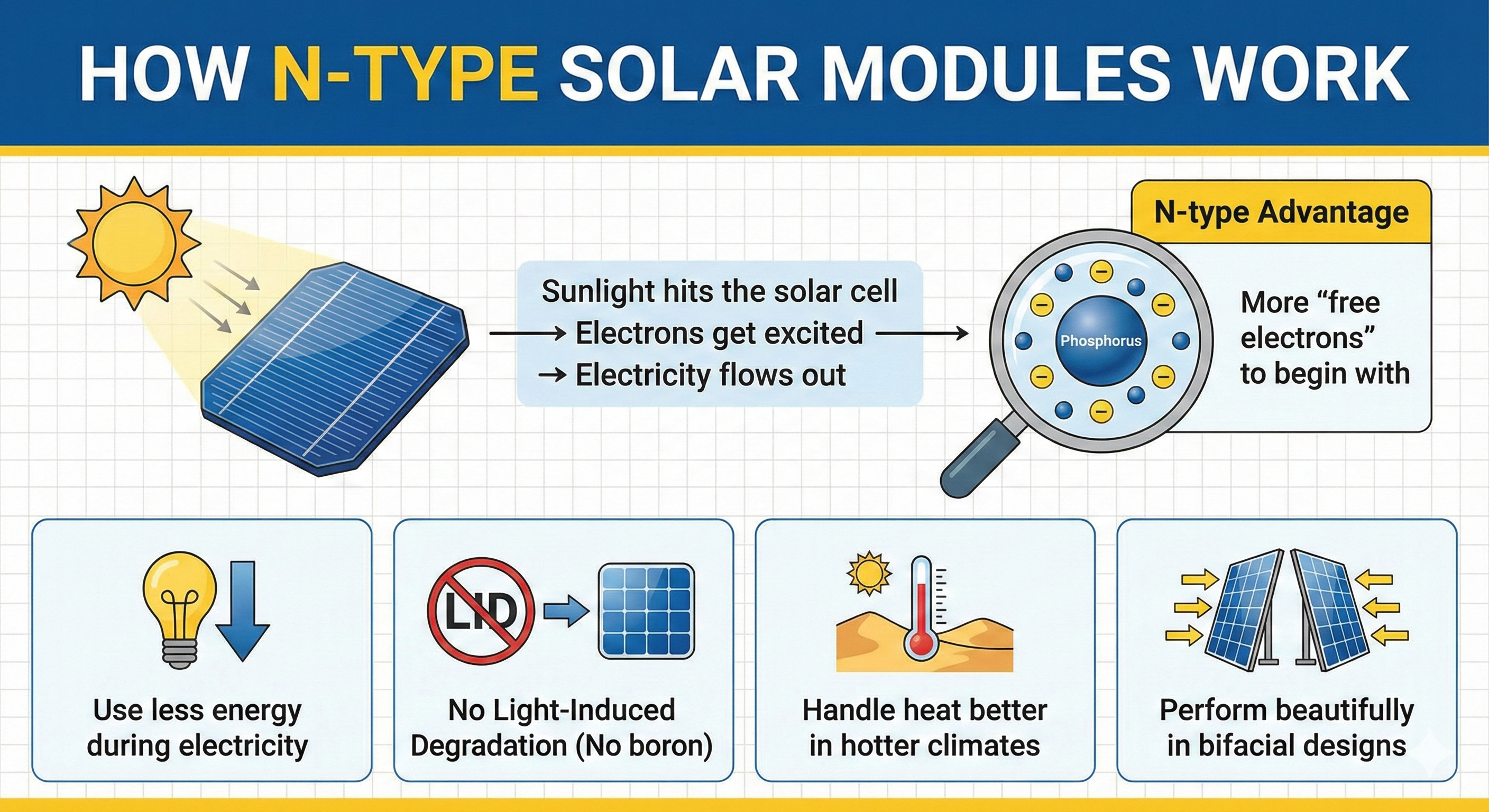
They have more “free electrons” to begin with. This happens since N-type is created using phosphorus, which naturally has extra electrons and more potential electricity.
They use less energy during electricity.
They don’t suffer from a big industry problem: LID. This is Light-Induced Degradation. And well, because N-type does not have boron, this early degradation problem simply doesn’t exist.
Also, they handle heat better. So in hotter climates, like most parts of India, this alone makes a massive difference.
They perform beautifully in bifacial designs as well. This is because they are structurally cleaner, and they capture light from both sides much more efficiently.
So overall, N-type solar panels simply use the same sunlight more smartly.
Less energy is lost. More power extracted. Longer life.
And there is no doubt that this is one of the biggest solar panel technology advancements of the last decade.
Benefits of N-Type Solar Modules
There is no doubt that there is a reason why solar manufacturers around the world, including Indian players like Emmvee, are shifting toward N-type technology. And let us tell you, these benefits are not just some subtle add-ons, but are actually big, noticeable, and long-term.
In this part, let’s walk through them one by one, so you know why exactly it matters so much:
Higher Efficiency
Efficiency simply means the amount of sunlight your panel can turn into usable electricity, and this is where N-type truly shines!
They have higher electron mobility.
They lose less energy internally.
They maintain their performance over time.
This is what adds up to a noticeably higher output. In fact, this single benefit is why a lot of installers recommend N-type when roof space is limited. So you can get more power from the same area.
Lower Degradation
Every panel, no matter how good, degrades. But some degrade more slowly, and N-type is one of them. Why? Well, because they don’t have boron. And when there is no boron → no boron-oxygen bonding → no early degradation.
So while older P-type modules lose up to 2–3% in the first year, N-type modules avoid that initial hit. What this does is help the panel maintain its performance curve over not months, but decades.
Better Performance in Heat
Let’s be honest: India is not sunny, it's hot! And heat usually reduces power generation in most panels. But N-type modules drop much less power as temperatures rise. They handle summer days more gracefully, which means more units are generated over time.
So this makes them ideal for:
industrial rooftops
commercial buildings
high-irradiation zones
utility-scale farms
Basically, anyone who lives in a hot region automatically benefits!
Bifacial Power Generation
One thing you should know is that most N-type cells pair beautifully with bifacial module designs! What Bifacial means is that the panel generates power from the front and the back. And the reason why this works so well is that the structure of the N-type actually allows more transparency and better light absorption from both sides. So guess what? This can add 5–30% more power, depending on the installation.
Longer Lifespan & Better Warranty Confidence
Last but not least, since N-type modules degrade more slowly and handle stress better, manufacturers generally offer stronger warranties. It is actually not uncommon to see a 25–30-year performance warranty or a 12-years of product warranty.
Many people get confused about the difference between P-type and N-type. So here, as we reach the end of the article, we will also take away that confusion:
N-Type vs P-Type Solar Panels (Quick Comparison)
Here’s a simple table you can read at a glance:
Final Thoughts
So now when someone asks you,
“What are N-type solar panels, and should I choose them?”
You have a clear, simple answer. It is genuinely one of the most meaningful solar panel technology advancements we have ever seen. It is something that actually improves lifetime generation, stability, efficiency, heat performance, and long-term value. So if you are someone who is planning to go solar for the next 25–30 years, efficiency and degradation matter. And that’s exactly where N-type solar panels win.
Also, we at Emmvee PV have already moved in this direction. Here, you can get N-type TOPCon modules with solid warranties. And not to forget, that it's highly efficient, which shows how strongly the industry believes in its technology.
In short: If you want future-proof panels that work harder, last longer, and generate more output, N-type solar modules are a very smart choice.