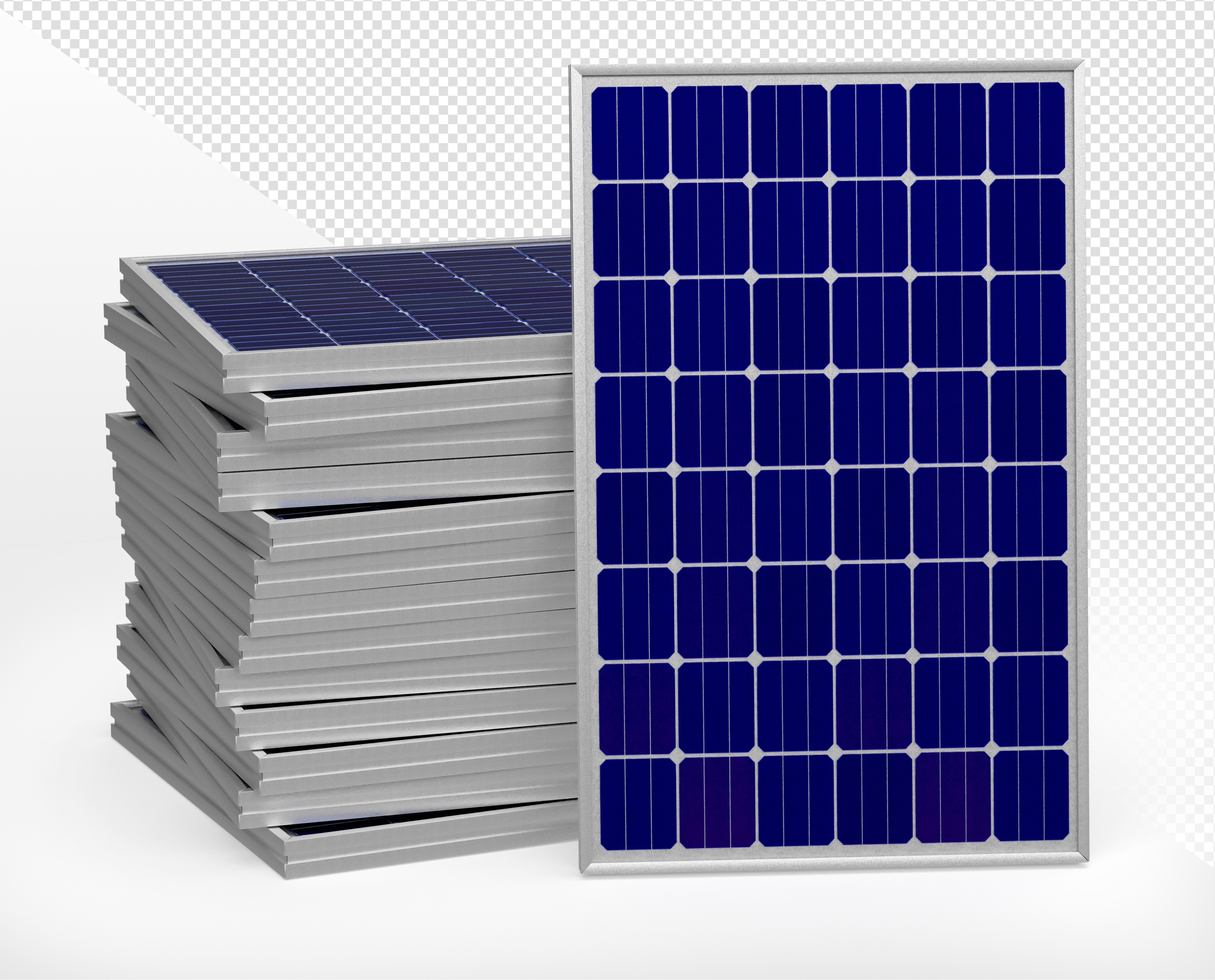
If you’ve been hearing more about bifacial solar panels lately, you’re not alone. They’re often described as the “future of solar,” and honestly, the hype is not without reason. These panels are smarter in choice, more efficient, and make much better use of available sunlight than traditional solar modules. If we explain in simple terms, then bifacial solar panels can absorb the sunlight from both the front and the back side. But how does that help? Well, it can significantly boost their output.
So the real question is: is it even worth switching to them? In this article, we will walk you through what bifacial solar panels are, how they work, their key advantages and challenges, and of course, why Emmvee's bifacial modules are among the best in the market today.
What Are Bifacial Solar Panels?
Imagine a regular solar panel. Now we all know that it absorbs sunlight from the top surface and converts it into electricity. Simple, right? Now imagine a panel that can absorb sunlight from both sides, that is, the front and the back. That’s literally what bifacial solar panels are!
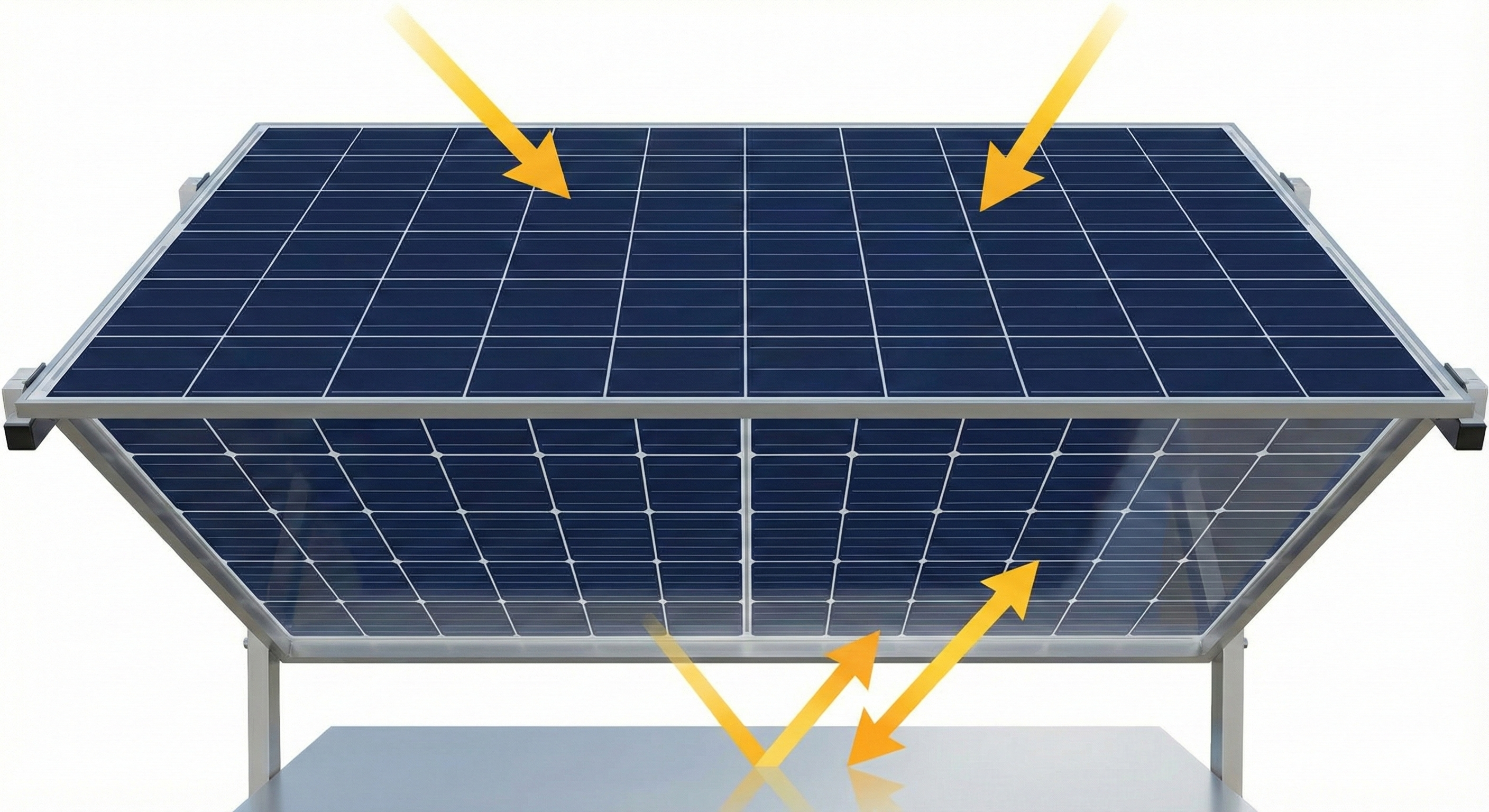
In easy words, bifacial solar panels generate electricity using direct sunlight on the front side and reflected sunlight on the backside. And guess what? Because of this dual-sided absorption, they naturally produce more power than traditional modules.
This is why the concept became more popular:
India and many sunny countries have high ground reflectivity (especially in concrete, white rooftops, desert regions, and snow zones).
More reflectivity = more backside sunlight = more energy generation.
More energy = higher returns and faster payback.
You see this extra energy output? That’s often referred to as a bifacial solar panel’s efficiency, and it's one of the biggest reasons industries, commercial units, and large solar farms are adopting them!
Now that we know what bifacial solar panels are, let’s talk about how they do what they do.
How Do Bifacial Solar Panels Work?
To fully understand how bifacial solar panels work, you can imagine holding a glass sheet that has solar cells sandwiched inside. Both sides are exposed to the sunlight, so there is no dark backing sheet, no blockages. This is what happens: Sunlight comes in from the front, gets absorbed, and any light that reflects off the ground or surroundings hits the backside and gets absorbed again. Don’t worry, we will also explain to you the very simple science behind this:
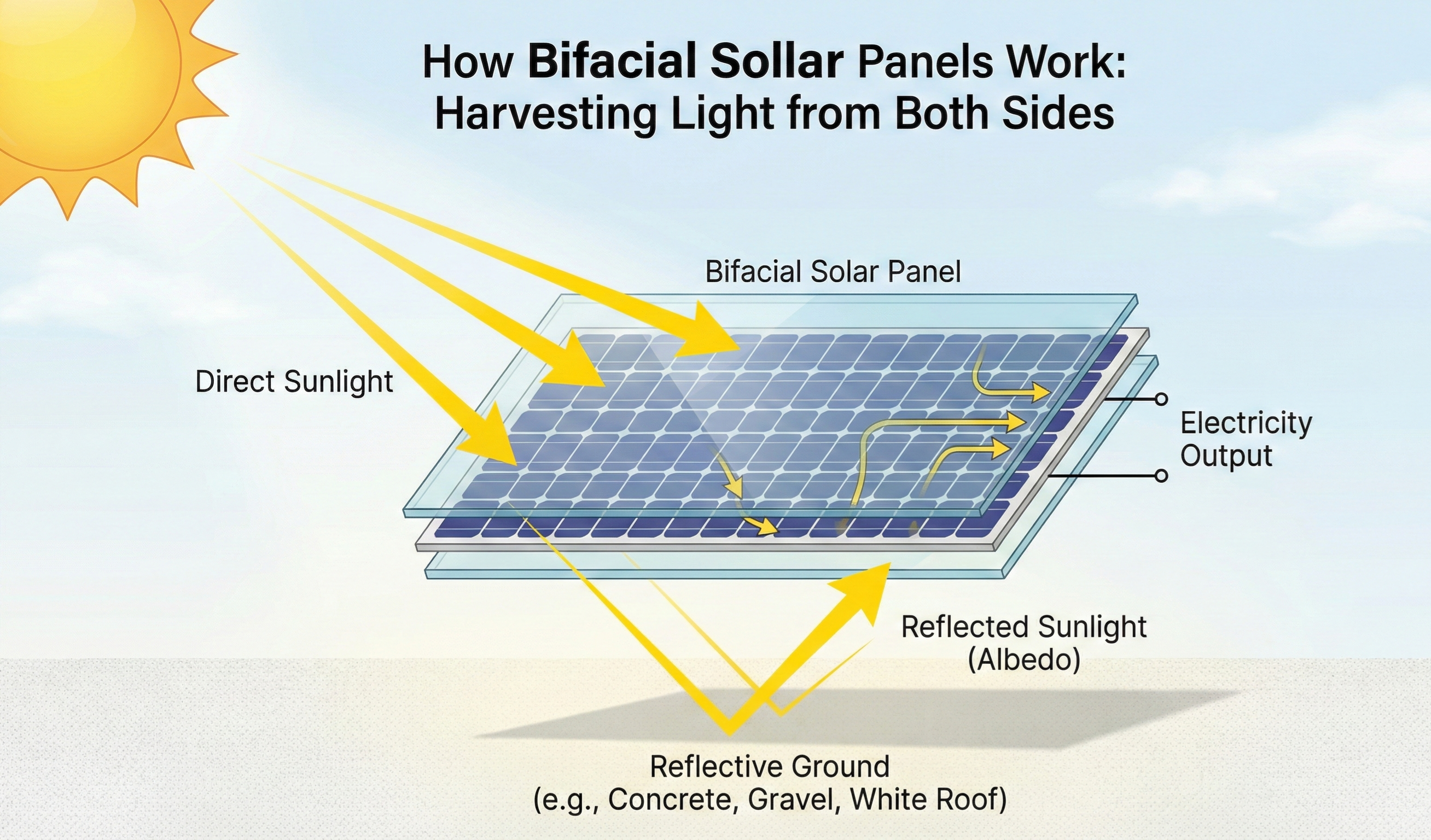
Dual-sided photons mean there will be more power. The front side is what captures direct solar radiation, and the backside captures reflected or scattered light.
Most of the bifacial solar panels are actually constructed with durable glass on both sides. This then gives you better durability, lower risk of micro-cracks, longer lifespan, and lower degradation.
These panels need enough space beneath them so that the sunlight can actually bounce up to the back surface. This is where elevated ground-mount systems, carports, and high solar stands come into the picture.
While they work beautifully on rooftops too, the biggest boost in bifacial solar efficiency comes from open spaces.
And that’s really the core of how bifacial solar panels work. That is by using both sides to squeeze out every extra unit of energy possible.
Advantages & Challenges of Bifacial Solar Panels
Yes, we all know how beneficial they are for the environment, but there are things beyond just thinking about nature. We get it. So, let’s break it down to help you understand the real-world performance.
Advantages of Bifacial Solar Panels
Higher Energy Generation
This one is the biggest win for real. In fact, most of the installations report 5-20% extra power output. And well, some can even go higher, as it depends on ground reflectivity.
Lower cost per kWh
Because the panels produce more energy, guess what? Your cost per unit generated naturally drops, too!
Better Performance in Harsh Weather
The glass-glass design also has its own benefits, such as:
Reduces hotspot formation, which is pretty common.
Minimizes PID, that is, Potential Induced Degradation
Increases lifespan
Perfect for Utility Projects
Solar farms, commercial rooftops, carports, and open fields achieve the greatest gains from bifacial technology.
Longer Lifespan
We saved the best one for the last: Because of stronger materials, many bifacial modules age more slowly than traditional ones.
Also Read : What are the Advantages of Bifacial Solar Panels
Challenges of Bifacial Solar panels
One of the challenges remains that it needs proper mounting. So if the backside is, let’s say, blocked for some reason or installed too close to the ground, the whole benefit won’t be in your favor.
We understand how the initial cost that you have to put in the panels can be slightly high. But the long-term ROI usually makes up for it!
Another challenge is that it works best with reflective surfaces. So if it's in places where there is low ground reflectivity, the efficiency jump will still be there, but not as high!
Here is also a solid difference between Monofacial and Bifacial, so you can understand the benefits you will be getting by choosing the latter:
Final Thoughts
If you are planning a solar installation, especially for a commercial roof, industrial project, or large plot, then bifacial solar panels are more than just a modern upgrade. They will be your smart investment. They have this ability to capture light from both sides, giving you more output, better returns, and a system that stays durable for years.
So to recap your key questions:
What are bifacial solar panels? It is panels that generate power from both sides.
How do bifacial solar panels work? They use direct sunlight on the front and reflected sunlight on the back.
Why choose them? Because they bring you higher efficiency, longer lifespan, and improved ROI.
Whether you are choosing solar for sustainability, cost savings, or future-proofing your infrastructure, bifacial technology stands out as a powerful option. It will always be the one that aligns perfectly with India’s climate and reflective environments.