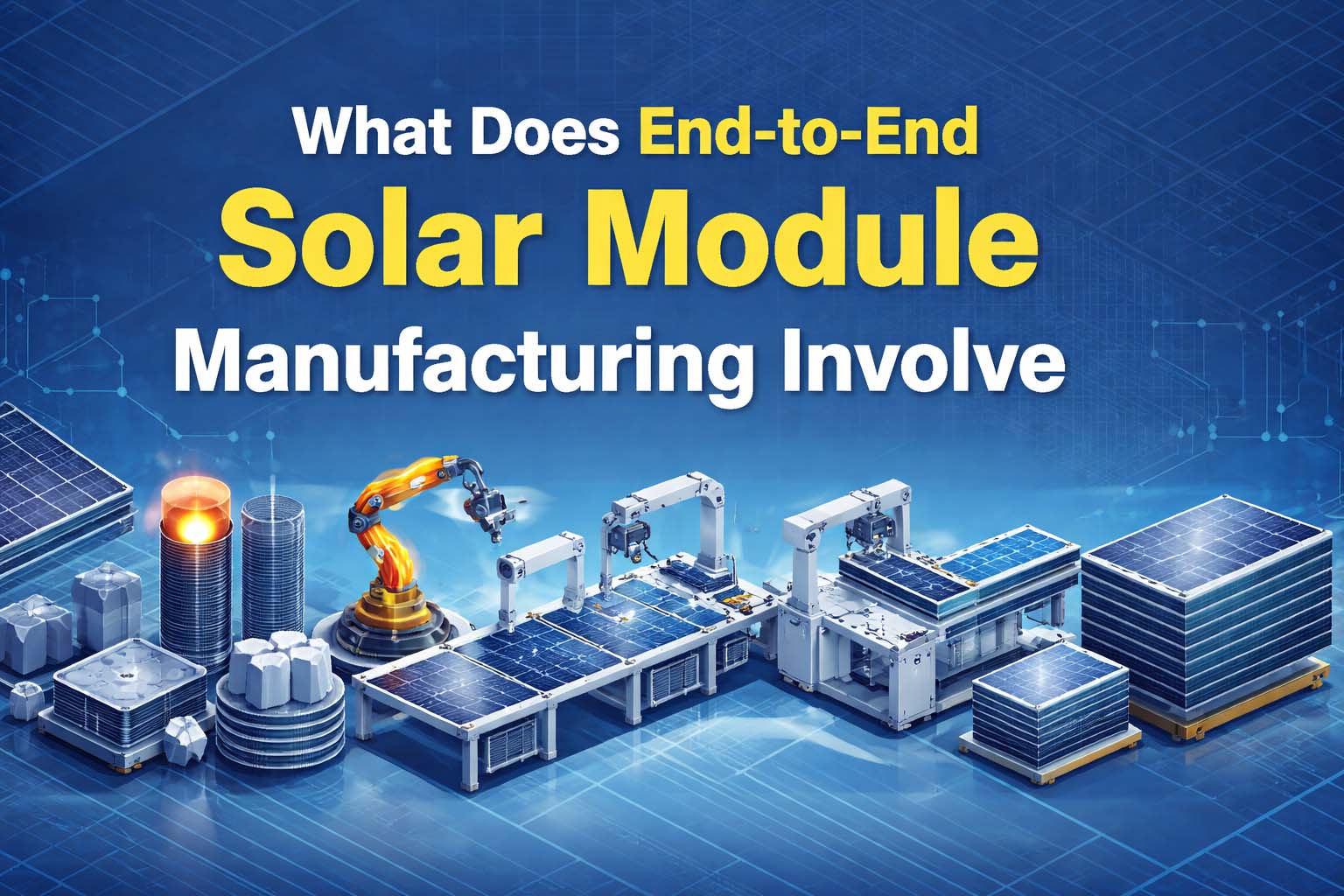
As global solar capacity scales rapidly, the focus is shifting from installation numbers to how solar modules are manufactured.
Indeed, in the context of utilities, EPCs, investors, and policy decision-makers, the reliability, performance, and lifecycle impact of a solar project increasingly depend on the strength of its manufacturing backbone.
End-to-end solar module manufacturing means control, consistency, and accountability over the entire production chain; from raw material processing to final module testing.
For Emmvee, integrated manufacturing is the core behind delivering world-class solar modules matching the requirements of commercial, industrial, and utility-scale projects.
By controlling every critical stage of production, it makes certain of quality, efficiency, and long-term durability across diverse operating conditions.
Understanding End-to-End Solar Manufacturing
End-to-end solar production refers to the entire manufacturing chain of a solar panel, from raw material sourcing to final dispatch, as opposed to a fragmented supply process.
Leaders in manufacturing solar PV modules, such as Emmvee, follow this holistic manufacturing paradigm to make sure that each and every component is produced to international quality parameters.
This leads to a solar module that functions efficiently under variable climatic conditions for decades together.
Raw Material Processing and Silicon Purification
The process begins with silicon, which is the raw material used in the manufacture of photovoltaic cells in solar modules. The silicon is purified using various processes to remove the impurities.
This is an important step, as the purity of silicon used in a solar cell affects its efficiency to a great extent. This process of purification also results in uniform electrical characteristics, which in turn leads to enhanced performance of the solar cell. Large organizations in solar cell production invest significantly at this stage. They place emphasis on strict material choices and quality standards to build a strong manufacturing process.
Solar Cell Manufacturing Process
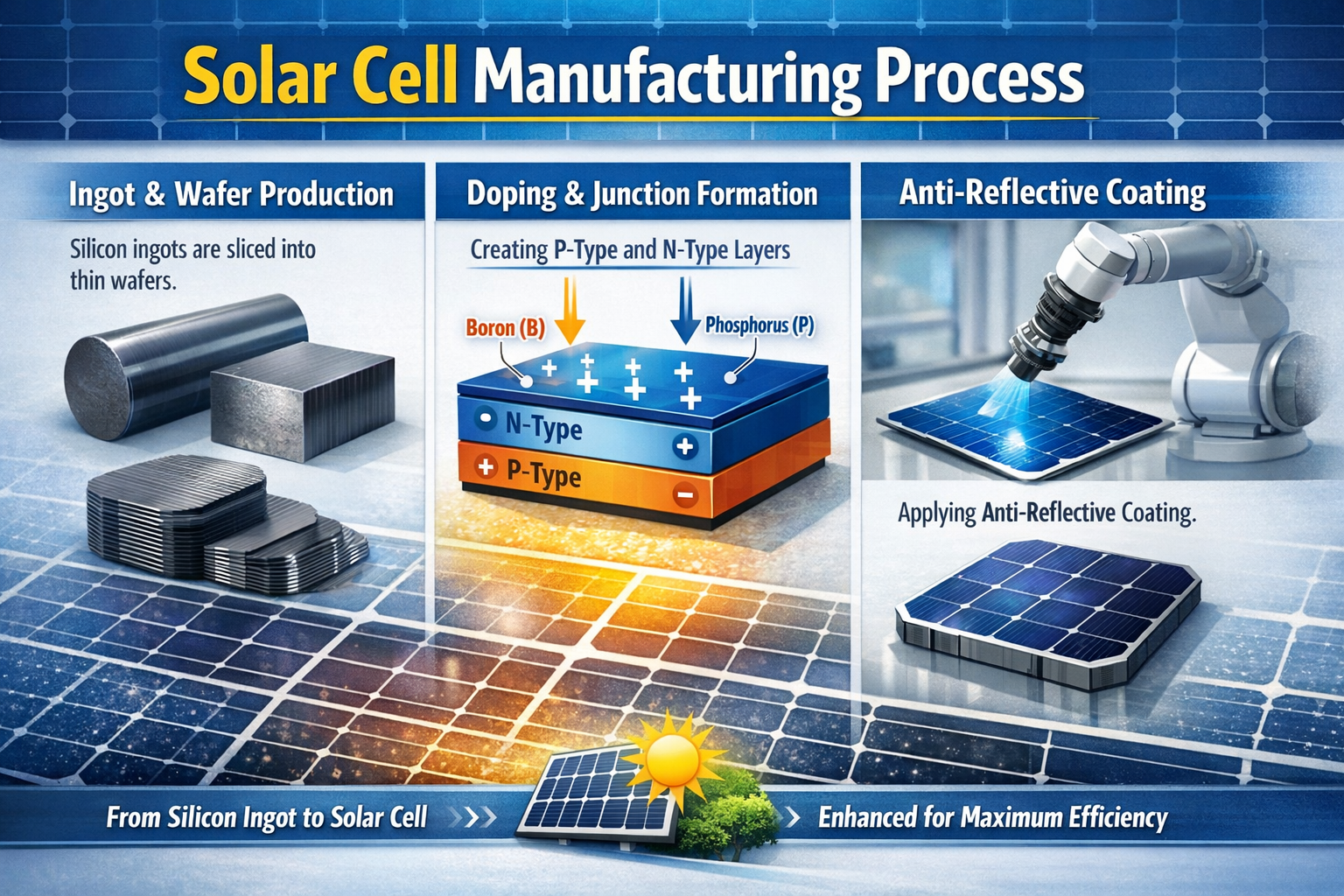
Purified silicon then enters the solar cell production process. This remains one of the most technical production phases in the overall solar production process.
Ingot and Wafer Production
The purified silicon is then melted and cast into ingots that are either cylindrical in shape or rectangular in cross-section. The resulting ingots are then cut into very thin wafers. This requires a high level of uniformity in the thickness of the wafers in order for the electrical properties to be consistent.
Doping and Junction Formation
The silicon wafer is doped with an element such as boron or phosphorus. This results in creating a region that is positive (p-type) and another region that is negative (n-type). This enhances the process of converting sunlight to electricity.
Anti-Reflective Coating
In order for maximum absorption of light to occur, an anti-reflective coating is deposited atop the wafer surface. This greatly helps in increasing the cell's efficiency by reducing the reflection of sunlight.
As one of the most experienced solar cell manufacturing companies, Emmvee addresses efficiency in solar cells to deliver high efficiency in solar modules.
Cell Testing and Sorting
Before solar cells can be assembled into solar modules, various testing phases are undertaken. Factors such as voltage, current, and efficiency are calculated when sunlight exposure is simulated.
Cells are sorted according to their performance rating. This process ensures that cells with similar electrical properties are combined together in a single module to avoid energy losses.
Solar Module Assembly
In this phase, the module assembly process combines several solar cells into a functional group. This phase determines all of the structural characteristics of a solar panel.
Cell Stringing and interconnection
The solar cells are connected in strings through conductive ribbons. The strings are aligned for maximum current and reduced resistance.
Lamination Process
The cells are then stacked together. They are encapsulated in sheets of encapsulant material. They are further protected on their back by a backsheet. All these are then laminated. Heat is applied to laminate them.
Framing & Installation of Junction Boxes
Anodized aluminum frames are incorporated to give strength to the device. Additionally, junction boxes are provided to enable easy and safe connections.
During this stage of solar panel manufacturing, it is crucial for the longevity of solar panels, particularly those that are mounted in harsh environments.
Quality Control and Performance Testing
Quality assurance is a hallmark of end-to-end solar manufacturing. Each module is tested before it can be accepted.
Electro Luminescence Testing
EL testing reveals micro-cracks, damaged cells, or hidden defects that may affect performance.
Flash Testing
The solar modules are subjected to simulated solar light in order to test their power, efficiency, and electrical properties.
Mechanical and Environmental Tests
Other tests include resistance to the action of wind, snow pressure, relative humidity, and temperature differences.
With Emmvee, it is ensured that international standards of quality are incorporated into each module through extensive testing.
Packaging, Logistics, and Dispatch
After passing quality checks, the solar modules are well-packed to avoid any breakage during their transportation. Well-planned logistics allow for timely delivery to project sites, whether rooftop installations or major solar farms.
The final step in solar panel manufacturing completes the entire course, ensuring that customers receive high-quality modules that are ready for immediate deployment.
Why End-to-End Solar Manufacturing Matters
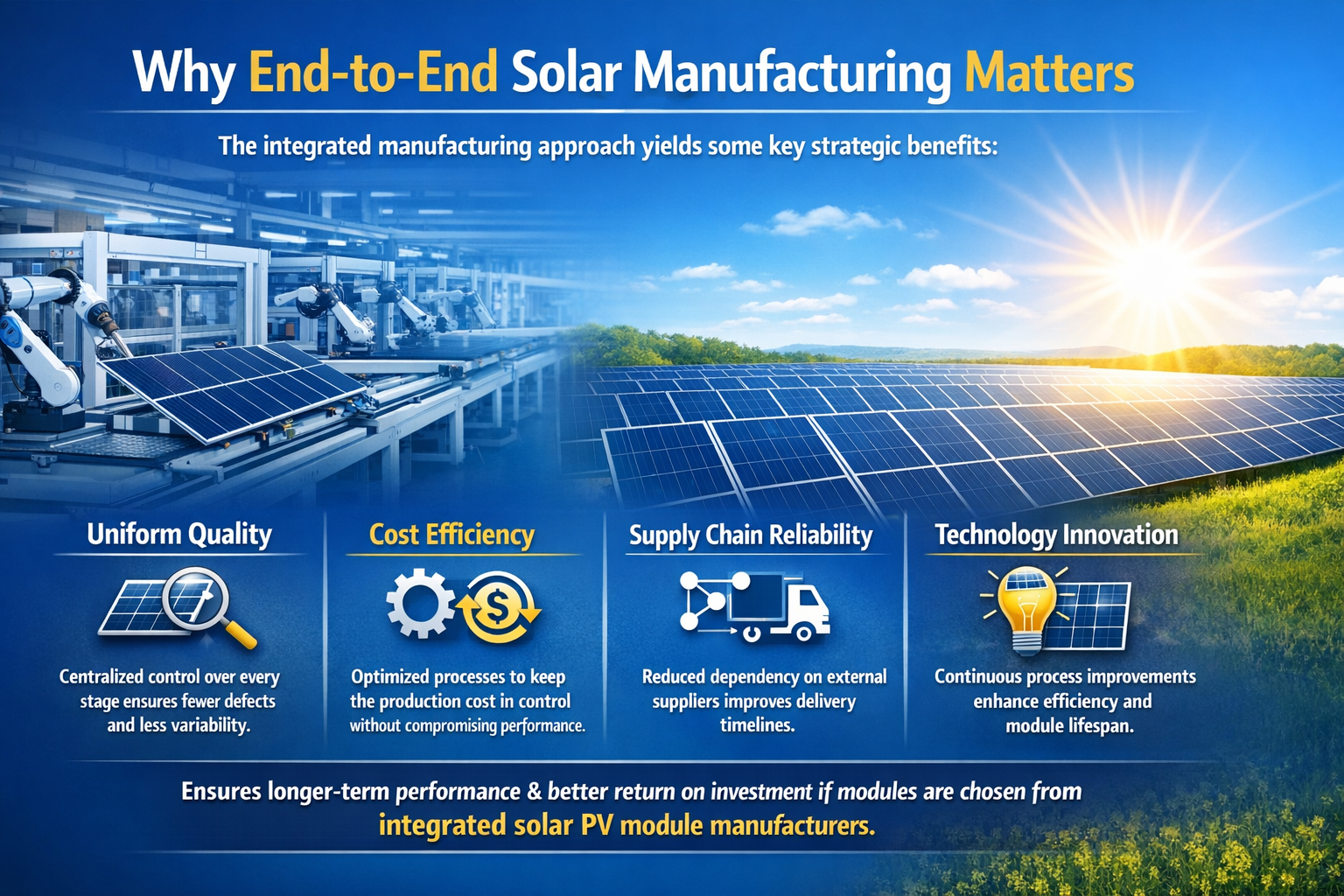
The integrated manufacturing approach yields some key strategic benefits:
Uniform quality
Centralized control over every stage ensures fewer defects and less variability.
Cost efficiency
Optimized processes to keep the production cost in control without compromising performance.
Supply chain reliability
Lower levels of dependence on external suppliers contribute to improvement in delivery timelines.
Technology innovation
Permanent improvement of process increases the efficiency and life span of modules.
It ensures longer-term performance and better return on investment for businesses and utilities if modules are chosen from integrated solar PV module manufacturers.
Emmvee’s Role in Integrated Solar Manufacturing
Having a rich experience of several decades in the field of renewable energy solutions, Emmvee is a well-known brand in the complete solar manufacturing process.
The vertically integrated facilities by the company ensure precision manufacture, quality control, and innovation.
Through the synergies of advanced technology and industry expertise, Emmvee provides solar panels that are capable of performing well in various segments, ranging from rooftop solar to utility-scale solar projects.
Assisting the Clean Energy Transition in India
As the pace of India’s renewables growth intensifies, the importance of credible solar cell manufacturers is also intensifying. In fact, a full-scale solar manufacturing industry not only enhances the nation’s manufacturing capabilities but also helps the country grow sustainably.
Emmvee promotes this evolution by manufacturing top-notch solar panels that meet the National and international targets in the drive for sustainability.
To Wrap Up
Understanding what end-to-end solar module manufacturing includes underlines the complexity, precision, and expertise that go into producing reliable solar solutions.
From silicon purification and the solar cell manufacturing process to module assembly and final testing, each step plays a significant role in ensuring performance and a durable lifetime.
The integrated manufacturing approach undertaken by Emmvee, one of the established Solar PV module manufacturers in India, echoes its commitment toward quality, innovation, and sustainability.
By investing in advanced processes and rigorous quality control, Emmvee continues to support the growing demand for clean, efficient, and dependable solar energy solutions.