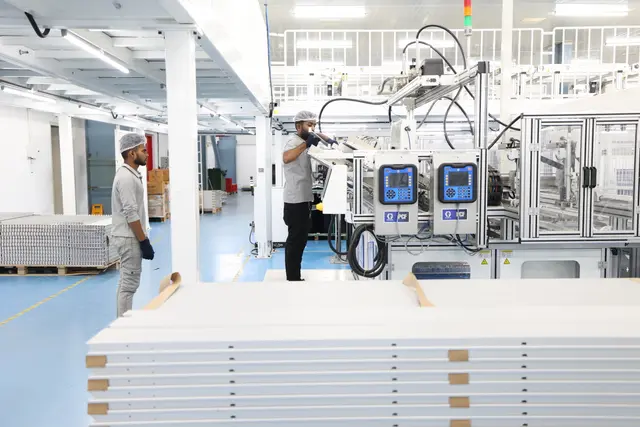
As the world moves rapidly toward cleaner energy solutions, solar power has become a front-runner in the global energy transition. Solar installations are expanding at a historic rate, particularly in India, where there is an abundance of sunlight and a growing demand for electricity.
However, have you ever pondered the true manufacturing process of a solar panel? When selecting solar modules, homeowners, investors, and buyers can make better selections if they have a better understanding of the solar PV manufacturing process.
In addition to affecting panel performance, high-quality manufacturing also affects the lifespan of your solar system.
We'll take you through the main steps in the Solar PV Module Manufacturing Process in this article, demonstrating the steps involved in creating a durable, high-performing solar panel.
Raw Material Sourcing: Where It All Begins
All solar modules begin with premium raw materials. These include:
The raw material used to make silicon wafers is polysilicon.
Glass sheets are utilized as the module's protective front.
Ethylene Vinyl Acetate, or EVA, is used for insulation and encapsulation.
Aluminum frames are for durability and structure.
Backsheet to shield against moisture and ultraviolet light.
Purity is important, particularly for silicon. A solar module's lifespan and efficiency may be shortened by impurities. Responsible sourcing is also important; many manufacturers, particularly in India, are now concentrating on using materials that are ethically and environmentally sourced.
This is the first, but most important, stage in the manufacturing process of a solar PV module.
Ingot and Wafer Production
Making useable wafers from raw polysilicon is the next step in the solar PV manufacturing process.
Melting the Polysilicon
High temperatures are used in a furnace to melt polysilicon.
Forming Silicon Ingots
After cooling, the molten silicon is formed into rectangular or cylindrical ingots.
Wafer Slicing
The ultra-thin wafers that make up solar cells are cut from these ingots.
There are two typical kinds:
Monocrystalline wafers
Having only one crystal, they are more efficient.
Multicrystalline wafers
These are less expensive but marginally less effective since they are made from numerous crystals.
This is essential to the entire solar PV manufacturing process and lays the groundwork for solar cell performance.
Cell Fabrication: Turning Wafers Into Solar Cells
Doping the Silicon
The process of producing P-type or N-type semiconductors by adding elements like phosphorus or boron.
Anti-reflecting coating
Increased light absorption is achieved by applying an anti-reflective coating.
Screen printing
To generate electrical channels, pastes made of aluminum and silver are deposited onto the wafer.
Testing and Firing
After heating the wafers to harden the contacts, they are examined electrically and visually.
The wafer then transforms into an active solar cell that can produce power from sunlight. In the solar PV module manufacturing process it is essential since it establishes how well the panel will function in actual use.
Module Assembly: Building the Solar Panel
After each solar cell is manufactured, it is put together to form a complete module.
Cell stringing is the process of creating strings by soldering cells together in succession.
Lamination is the layers of glass, backsheet, and EVA are positioned between strings.
Framing is the edges of the module are shielded by an aluminum frame.
Installation of the Junction Box is the electrical output is connected via a junction box located at the rear.
Using sophisticated automation and stringent quality control, Emmvee, a top solar module manufacturing company in India, guarantees that every module is constructed precisely to produce panels that endure for decades.
Testing and Quality Control
Electroluminescence testing, or EL testing, finds hidden flaws or microcracks.
IV Curve Testing evaluates the module's voltage and current performance in the presence of light.
Extreme temperatures, UV exposure, and humidity are all simulated in environmental stress tests.
Check for the certifications, as panels need to adhere to IEC, MNRE, BIS, and other standards.
This step is essential to the Solar PV Module Manufacturing Process and guarantees that clients will obtain durable, high-performing goods.
Packaging and Logistics
The modules are meticulously packed for safe transportation after passing quality testing. Proper packaging avoids:
Tiny cracks
The process of delamination
Water intrusion
Deformation of the frame
In order to guarantee that modules arrive at installers on schedule and in ideal shape, manufacturers also carefully manage logistics, whether shipping locally or abroad.
This step, which is frequently disregarded, affects the quality of the final installation and is still a component of the wider Solar PV Manufacturing Process.
Sustainability in the Manufacturing Process
Sustainable practices are becoming more and more prevalent among contemporary solar manufacturers, both in terms of their output and their production methods.
Energy Efficiency: Producing modules at solar-powered plants
Water recycling: Reusing water for cooling and cleaning wafers is known as water recycling.
Waste Reduction: Reusing discarded materials and damaged cells
 Sustainability is included in Emmvee's production process at every stage. As an ethical solar module manufacturer in India, it is dedicated to providing premium solar technology while reducing its environmental impact.
Why Manufacturing Quality Matters for You
Price and efficiency are the primary considerations for most solar buyers; however, a panel's manufacturing process has a direct impact on:
Performance in practical settings
Resistance against deterioration of the environment
Longevity and warranty coverage
ROI (return on investment)
Always choose a reputable manufacturer when purchasing solar, such as Emmvee, where state-of-the-art technology is combined with top-notch quality control. It is essential for your peace of mind, system longevity, and energy savings.
To wrap up
The procurement of raw materials, wafer manufacturing, cell fabrication, module assembly, stringent quality testing, safe packing, and sustainable practices are all steps in the intricate and extremely complex Solar PV Manufacturing Process.
You may better appreciate the engineering, accuracy, and attention to detail that go into creating a high-quality solar panel if you comprehend each of these phases. Therefore, if you're thinking about making the transition to solar, go beyond pricing comparisons.