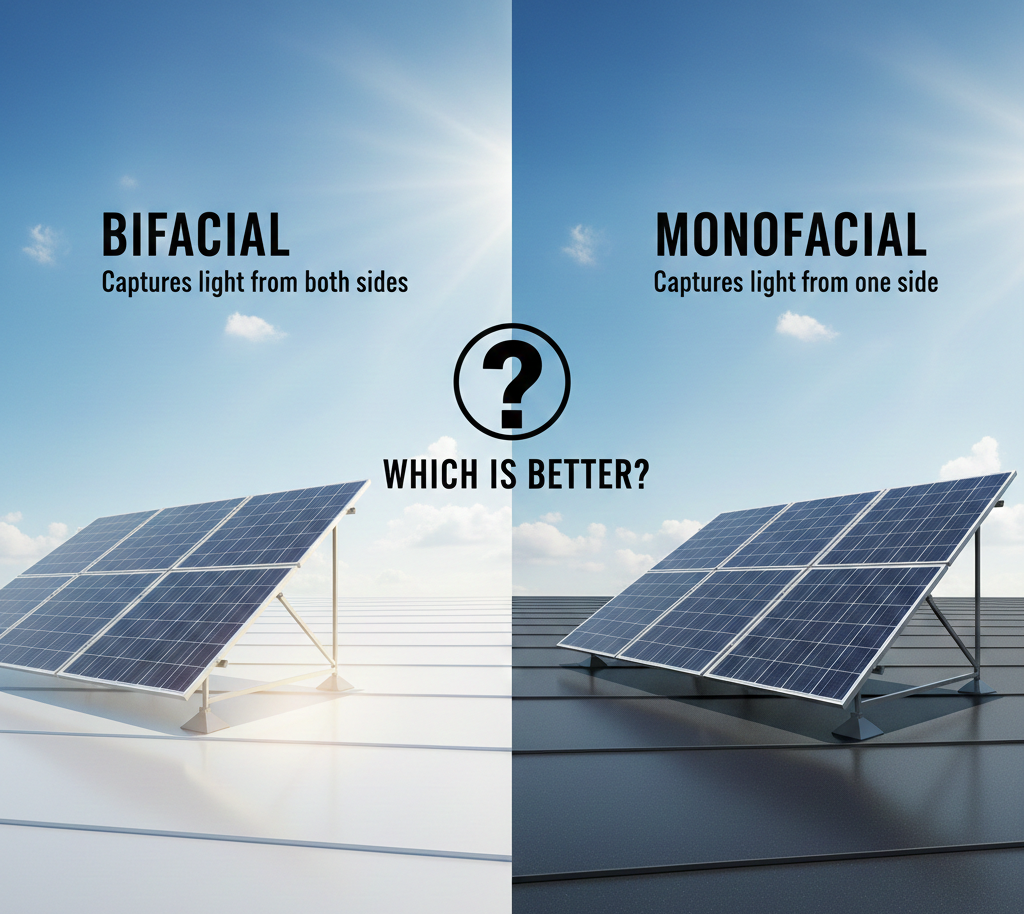
If you have been researching solar panels for your home, business, or industrial project, you’ve probably come across two terms over and over again: bifacial solar panels and monofacial solar panels. And the biggest debate everywhere remains the same: bifacial solar panel vs monofacial, and which one should you actually choose?
Solar technology has evolved at a rapid pace over the last few years. Earlier, if you asked anyone, they would suggest going for monofacial panels as they dominated the market. But bifacial modules quickly entered the scene and changed the dialogue around bifacial solar panels efficiency and long-term power yield.
However, still, choosing between the two can still feel confusing when they both claim to offer the best solution. So this article is here to cut through the noise and help you understand the difference between mono and bifacial, their technologies, bifacial solar panels efficiency, where each one shines, where each one struggles, and most importantly, which one makes more sense for you!
Let’s break down the bifacial solar panel vs monofacial confusion!
What Are Monofacial Solar Panels & How They Work?
We want you to imagine a solar panel that absorbs sunlight only from one side, that is, the front. That’s exactly what monofacial solar panels do. They are the most common type of panels installed across India and globally, and no doubt, they have been powering homes for decades.
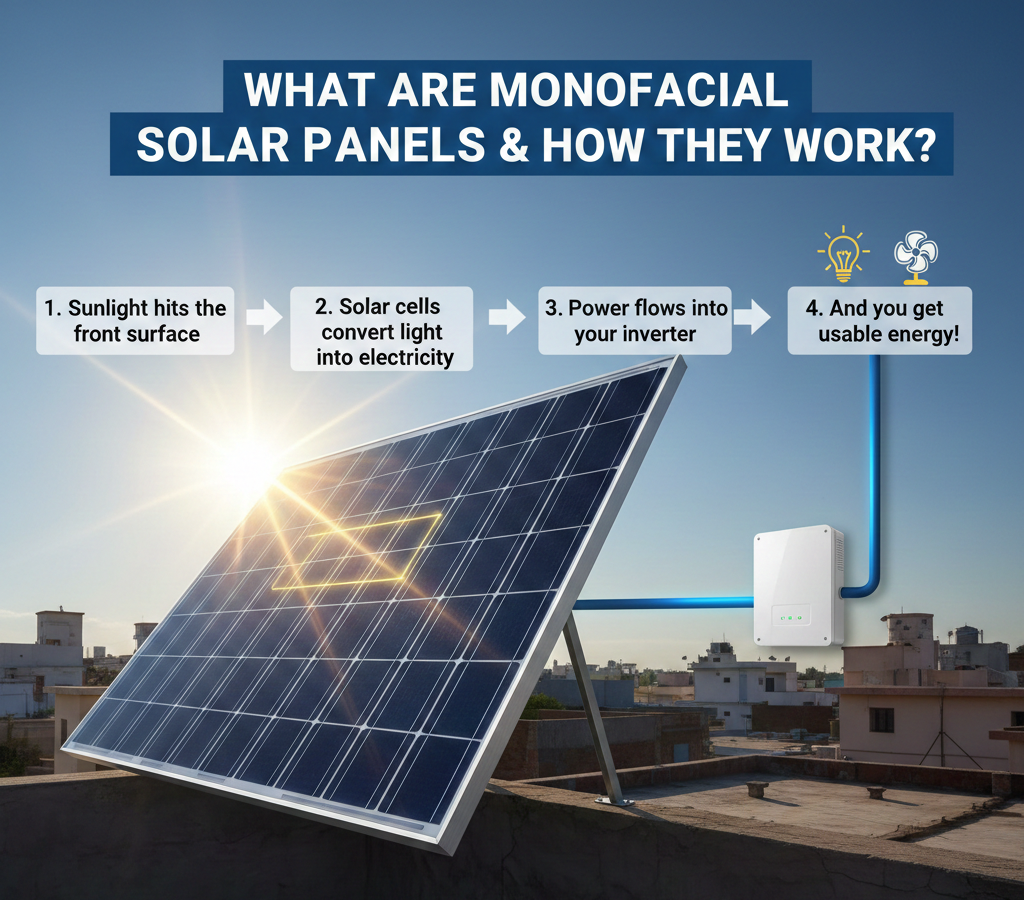
Many people ask: “How Monofacial Solar Panels Work?” Here is your answer:
Sunlight hits the front surface → solar cells convert light into electricity → the power flows into your inverter → and you get usable energy. That’s it.
The reason why people choose monofacial modules is because of the Advantages of Monofacial Solar Panels, such as:
They are affordable, and the upfront cost is not as much.
They are lightweight and easy to mount.
They perform reliably on almost all types of rooftops.
They don’t require elevated mounting or reflective flooring.
But when discussing bifacial solar panels vs monofacial, one thing to remember is that monofacial modules give a predictable output. Like, we know that the panel only captures light from one direction, so performance is easy to estimate and optimise.
What Are Bifacial Solar Panels & How They Work?
Now, bifacial solar panels are a little different. You can think of them as panels that basically absorb sunlight from both sides. They generate power not only from the front surface but also from the rear side, by capturing reflected light from the ground, roof, or surrounding surfaces.
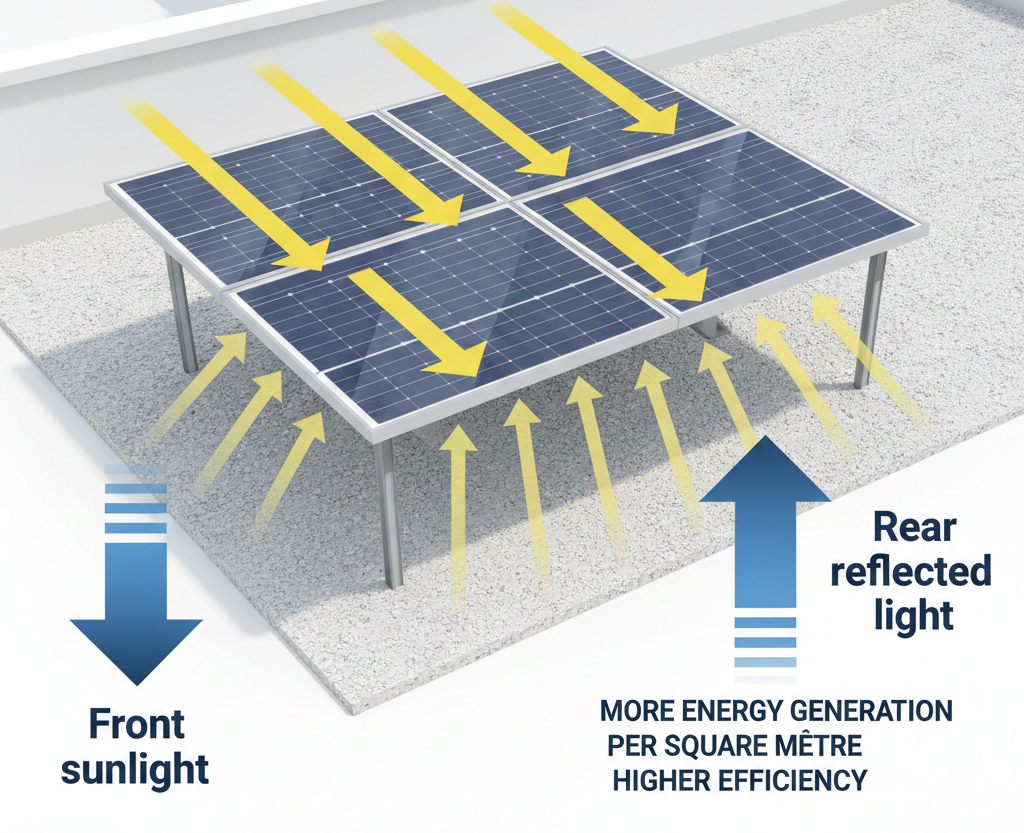
So, naturally, bifacial solar panels efficiency is technically higher because you're not limiting the panel to just direct sunlight. Instead, you’re using the reflected sunlight too. Here is how they work:
Front sunlight + rear reflected light = more energy generation per square metre.
This is why the talk about the advantages of bifacial solar panels has become a big thing in the industry. Because if you have the right setup by the right manufacturer, like Emmvee, then bifacial modules can give a significant bump in energy yield. Which, if you know, can be a great win!
But of course, this still does not make choosing between a bifacial solar panel vs a monofacial one, as it's not just about potential yield. It also depends on installation structure, reflectivity level, shadows, and even the mounting height.
Bifacial vs Monofacial: Pros & Cons Table
Now that you know the difference between mono and bifacial Solar Panels, there is a comparison that will make taking the decision easier:
From this table of differences between mono and bifacial solar panels, you can capture why the advantages of monofacial solar panels still matter and why the advantages of bifacial solar panels are so appealing for the long term. At the same time, looking at the disadvantages of bifacial solar panels will help you avoid expecting too much. After all, they are not magic devices that can perform the same everywhere. We hope you got the heart of the bifacial solar panel’s advantages and disadvantages, and why the decision can’t be one-directional for everyone.
Which One Should You Choose?
Finally, it's time to decide. If we were to offer you the best advice, it would be to contact us and discuss your needs. At Emmvee, we offer the best solutions for your solar needs and will suggest what suits your needs and space. One thing you should take away is that the final decision between a bifacial solar panel vs a monofacial should depend on your rooftop conditions, your budget, and your energy goals.
So, you can choose Monofacial Panels if:
You want a cost-effective solar setup
You have enough installation space
You want predictable output with no additional installation conditions
And go for Bifacial Panels if:
Your roof is reflective / coated / tiled / white-painted
Your structure allows open mounting with height
You want the highest power output per square metre
You prioritise long-term yield over upfront cost
And here is what nobody will tell you: The disadvantages of bifacial solar panels mainly show up only when the installation conditions are not suitable. If you install them on a dark terrace floor with minimal air gap, their rear side simply cannot contribute much. On the other hand, if your site is well optimized, then the advantages of bifacial solar panels can outweigh the cost difference and give a much better ROI over the years.
This is why the whole debate of bifacial solar panel vs monofacial isn’t about which technology is “better,” and instead it’s about which one is better for you.
Final Thoughts
There is no denying that solar is not a small purchase. It's actually an investment that affects your electricity bills for the next 20–25 years. And that is exactly why clarity matters more than trends.
So to sum it up, we can say that yes, Monofacial panels are simple, cost-effective, and pretty reliable performers that too, on almost all rooftops. If you are looking for higher potential and more power in your output, Bifacial panels can make a huge difference. The only thing to consider is the disadvantage of bifacial solar panels that whether if installation site supports this. So instead of asking, “Which is the best panel in the market?”, the smarter question is:
“Which panel will perform the best on my roof?”
Because at the end of the day, the real winner in the bifacial solar panel vs monofacial debate isn’t a product. It’s the option that fits your budget, your conditions, and your long-term expectations.