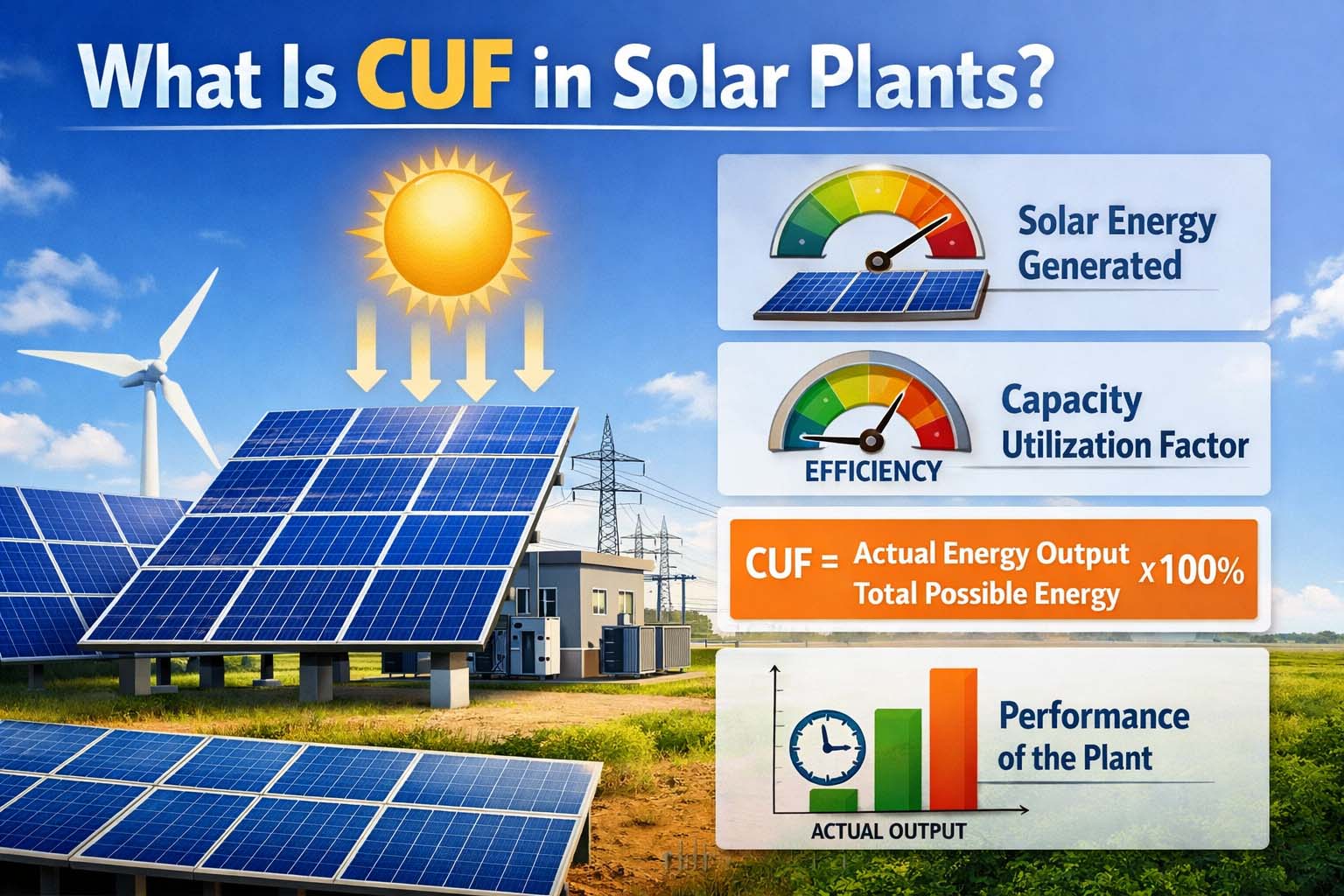
The Indian solar market has experienced significant growth during the last ten years due to aggressive targets for renewable energy and decreasing technology costs. Although initial dialogue was largely limited to its capacity, this is now changing and moving in performance-oriented assessment.
CUF in solar plants has become one of the most significant parameters in assessing project success.
Given the nearness to the year 2026, it is very important for developers, as well as policymakers, utilities, or corporate energy buyers who require reliable deployment of solar power, to understand CUF.
What Is Capacity Utilization Factor?
CUF (Capacity Utilization Factor), the CUF performance indicator measures the efficiency of a solar power station in using its capacity to produce electricity in a certain period, which is a year in general.
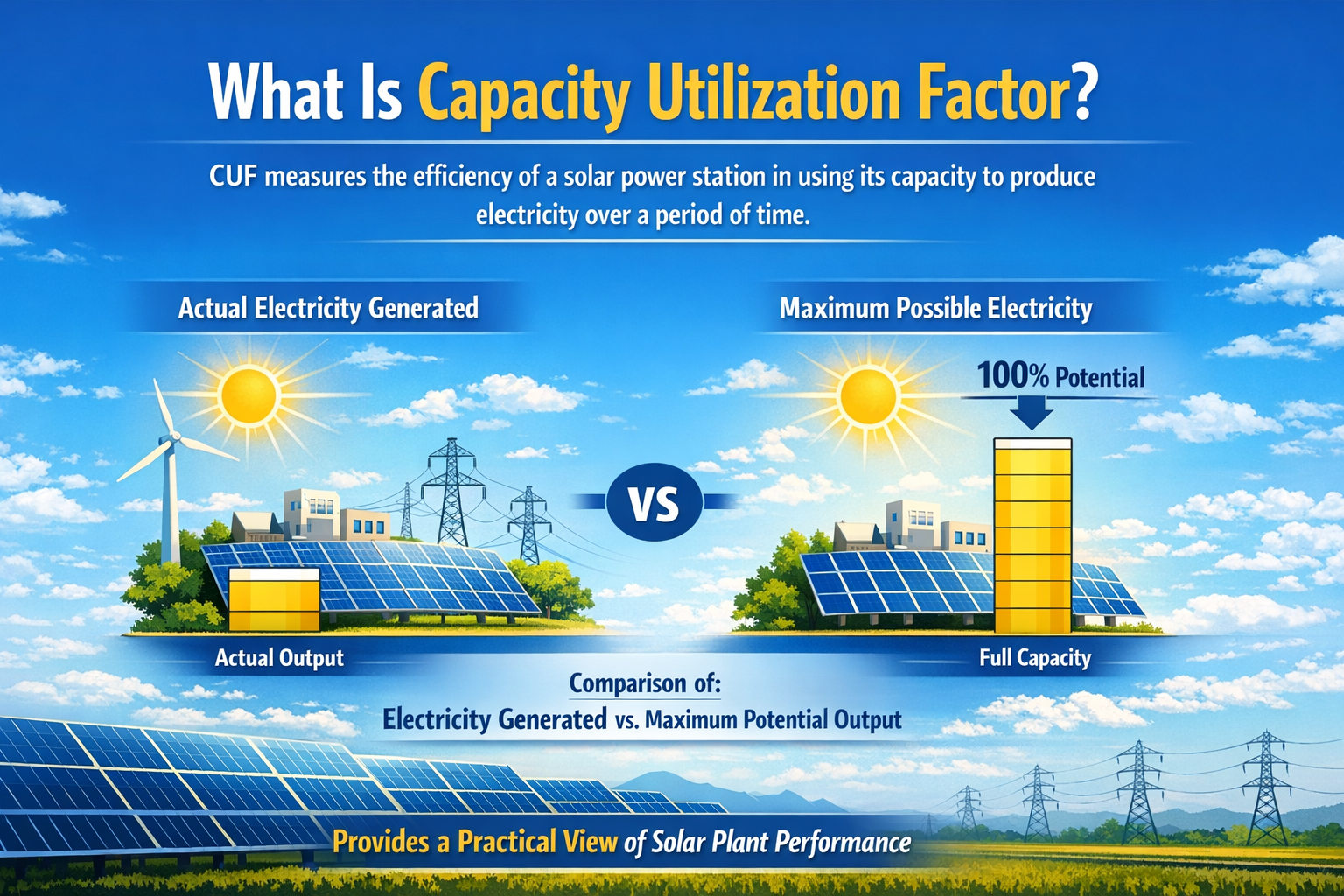
In other words, CUF reveals that:
What kind of electricity does a solar power plant generate?
Compared with what it could have produced at its maximum electricity if it had run at its fullest potential at all times
The utilization factor of a solar plant allows a practical view of the working of a plant when it is operational.
What is Capacity Factor in Energy?
To better understand CUF, it is important to know what is capacity factor in energy?
To help grasp what CUF is, it is necessary to define capacity factor with regard to energy.
The capacity factor is a common term that is used in all energy technologies. It is the ratio between:
Power Output
Max Possible Energy Generation
In the context of solar power, the capacity factor of solar plants is lesser than conventional power plants because solar plants have dependence upon sunshine availability and day-night variations.
Thus, in solar power plants, the capacity utilization factor becomes a prominent measure of evaluation.
Solar Capacity Factor and CUF: How They Are Related
Solar capacity factor and CUF may be considered interchangeably, especially in the context of the Indian renewable energy sector.
Although capacity factor is an energy term worldwide, it is generally observed that CUF is used in the context of evaluation in the case of solar projects in India.
Both are used in understanding the efficiency of the solar resource in generating usable energy from their installed capacities.
Importance of CUF Over Installed Capacity
In order to understand the significance of installed
Installed capacity does not provide an indication of overall energy production. Two solar power stations with the same installed capacity may yield very different results, thanks to:
Location and solar irradiance
Module efficiency
System design
Quality of Operations and Maintenance Work
For this reason, CUF in solar plants is increasingly employed in assessments of:
Financial result
Energy yield
Long-term sustainability
With market maturity, CUF is a more significant factor than megawatts installed.
How to Calculate Capacity Utilization in Solar Plants
One of the areas of inquiry that has been of interest to various parties is capacity utilization in solar power projects.
CUF Calculation for Solar Power Plant:
The formula for CUF calculation for a solar power plant is
CUF (%) = (Actual Energy Generated / Maximum Possible Energy) × 100
This formula is widely accepted throughout the industry for calculating the capacity utilization factor for solar plants.
How to Calculate the CUF of a Solar Plant
We need to learn how to compute the CUF for the output from a solar plant with the help of a simple example.
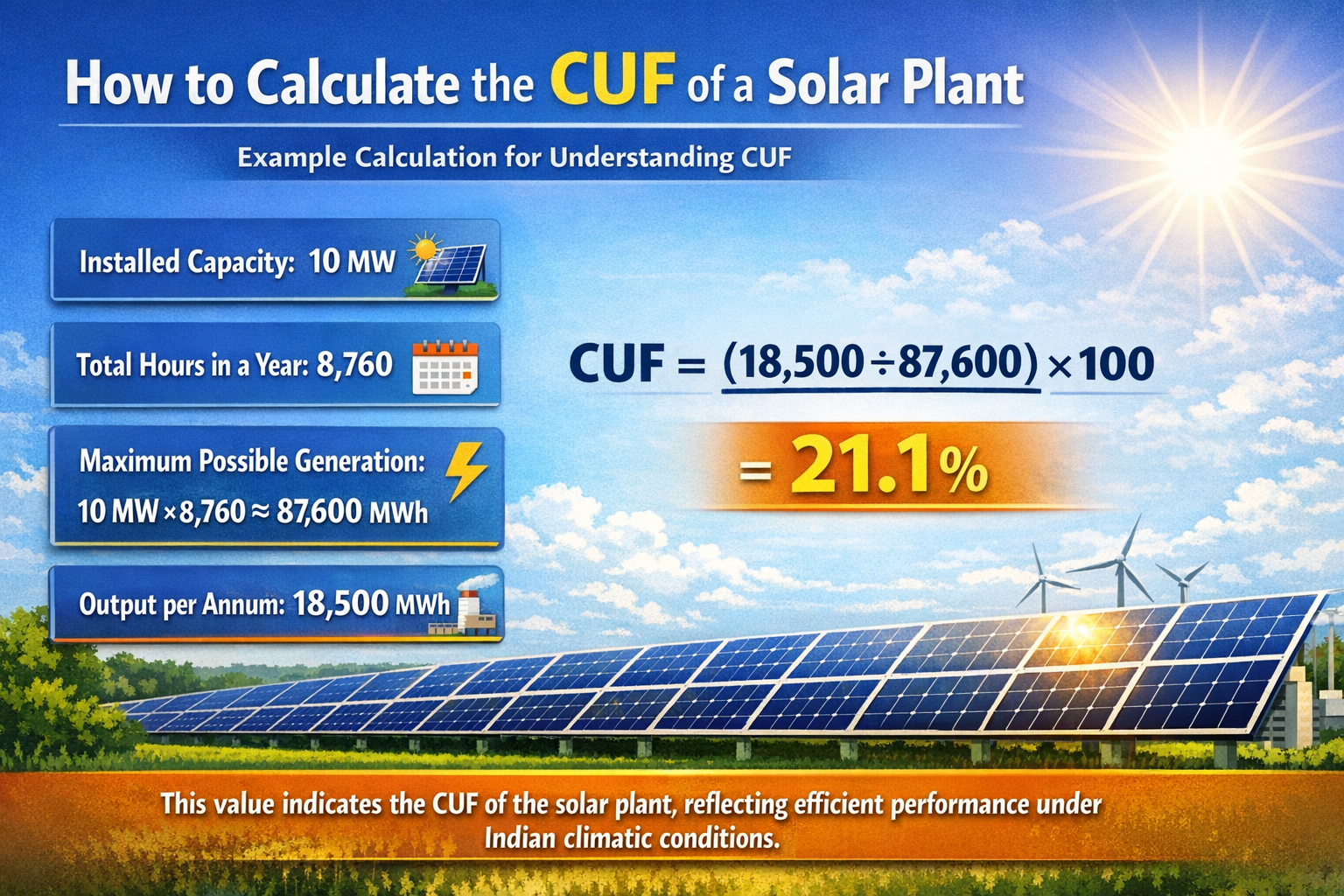
Installed Capacity: 10 MW
Total hours in a year: 8,760
Maximum possible generation: Maximum possible
10 MW × 8,760 ≈ 87,600 M
Output per annum: 18,500 MWh
CUF = (18,500 ÷ 87,600) × 100 = This value indicates the CUF of the solar plant, reflecting efficient performance under Indian climatic conditions.
CUF of Solar Power Plant in India
The CUF of solar power plants for India keeps changing based on geographical and climatic conditions, as well as technology employed. Typically, the CUF for India falls between 17% and 25%.
Regional Trends
Regions that receive intense irradiation like Rajasthan and Gujarat experience higher CUF
Southern and eastern parts get moderate amounts of CUF because of humidity and cloud cover
Rooftop systems may indicate slightly low CUF due to constraints such as shading
These examples underscore the significance of precise CUF estimation during project planning.
Key Factors Affecting Capacity Factor of Solar Plants
There are various technical and environmental conditions affecting the capacity factor of solar power systems.
1. Solar Irradiance and Climate
Availability of sunlight is the determining factor for the quantity of CUF. The brighter the area, the better the energy yield.
2. Module Technology and Quality
Efficient modules with better temperature coefficients produce higher electricity during real operating conditions. Major companies such as Emmvee are working on effective photovoltaic technologies that help enhance energy production with stable CUF ratios even in the variable climate conditions found in India.
3. Plant Design & Engineering
Tilt angle, orientation, row spacing, and inverter size become particularly important in ensuring a higher capacity factor of a solar setup.
4. Operations & Maintenance
Dust buildup, breakdown of equipment, and maintenance delay can greatly affect the level of CUF. Its monitoring and maintenance on a periodic basis are necessary for it to continue performing well.
Why CUF Will Matter Even More in 2026
As the renewable content increases in India, the role of CUF will be very important for the solar segment.
From Focus on Capacity Enhancement to Emphasis on Energy Production
The year 2026 marks a pivot to focus from installed capacity to the actual electricity delivered to the grid.
Investor and Lender Expectations
The financial institutions have increasingly started considering projects on the basis of realistic CUF projections. The CUF projections are essential in accurate revenue estimation.
Competitive Bidding and Tariff Pressure
As tariffs face pressure, it means that receiving an improved margin in the capacity utilization factor for solar plants can greatly influence project profit.
Grid Planning & Grid Stability
This knowledge of patterns helps the power companies predict the production levels of power and efficiently integrate solar energy into the electricity grid.
Role of Quality Solar Modules in Improving CUF
Quality modules are necessary to ensure the viability of CUF throughout the life cycle of a project. Companies like Emmvee have developed solar modules with:
High Conversion Efficiency
Increased performance at higher temperatures
Long-term reliability
These aspects enable solar power plants to have high solar capacity factor values every year.
CUF vs PLF: Key Difference
CUF is usually associated or compared to PLF (Plant Load Factor), which applies to thermal power plants. Though PLF relates to controllable power plants, in the case of solar plants, CUF considers the natural intermittency of the source and is, therefore, a better measure of their effectiveness.
To Wrap Up
Understanding what CUF is in solar plants is extremely essential to the future of India's solar industry. As the sector evolves, CUF will become the key indicator of:
Project effectiveness
Financial viability
Energy reliability
Value addition, therefore, comes from correct CUF calculation for solar plants, deploying high-quality technology, and long-term performance.
Long-term high output will be created by adopting better technology with value-for-money solutions provided by trusted manufacturers like Emmvee, allowing solar power plants to achieve higher CUFs and help India's ambitions of Clean Energy in 2026 and beyond.