
As the use of solar energy inches closer to widespread adoption, despite the differences in the various climatic regions, it has become necessary that several aspects that might affect the energy produced from solar panels come under consideration.
Among the most important, though widely neglected, aspects affecting the performance of a solar panel is the effect of temperature. This occurs despite the fact that solar energy is a result of sunlight.
In this blog, we shall learn about the impact of temperature on solar cells and the implications of solar panels temperature coefficients. Also, the importance of employing solar modules that are temperature-resistant, such as those produced at Emmvee.
So, let’s start.
Understanding the Temperature Effect on Solar Cells
The testing and rating of solar panels are done based on Standard Test Conditions (STC), in which the cell operating temperature is set to 25°C.
However, in practical conditions, especially in a tropical or arid environment, the operating temperatures of solar panels tend to be well above this standard.
The temperature effect on solar cells can be defined as the reduction in voltage and power with the rise in the temperature of the solar cell. Contrary to popular views, solar panels do not work effectively on hot days.
The truth is that, despite the temperatures not having any considerable effect on the current, they lower the voltage levels with the consequent reduction in power production.
This temperature-dependent behavior means it is necessary to take into consideration the solar module performance against the effects of heat, especially for installations carried out within high-temperature environments.
What Is a Solar Panel Temperature Coefficient?
The solar panel temperature coefficient is a number that shows the change in the power of the solar panels with each 1°C above 25°C. It is measured on a scale of percent per degree Celsius.
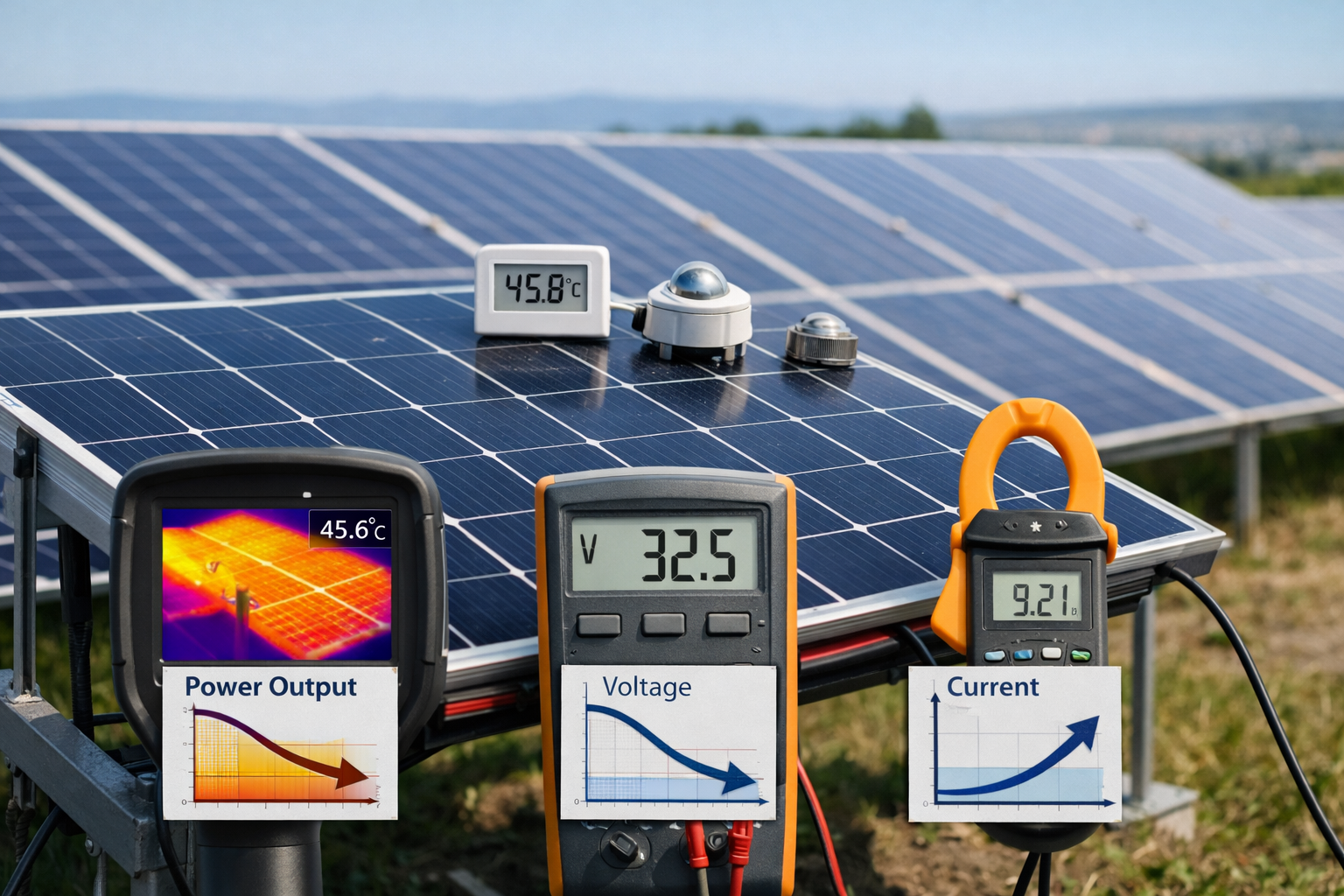
Generally, there are three temperature coefficients related to photovoltaic modules:
Power temperature coefficient
Plays a crucial role in determining how much a solar panel’s power output decreases as temperature increases.
Voltage temperature coefficient
Shows how the panel’s voltage changes with rising temperature.
Short-circuit current temperature coefficient
Indicates how the panel’s current varies with temperature changes
In this regard, the most critical among the above-listed parameters is the power temperature coefficient.
Solar Cell Efficiency vs Temperature: The Technical Relationship
The relationship between solar cell efficiency vs temperature is described by semiconductor physics. With increasing temperatures, the following occurs:
The band gap of the semiconductor material reduces
Electron activity increases
Open-circuit voltage drops
This results in low conversion efficiencies even when the intensity of sunlight is high. In turn, two different solar panels with equal wattage can have vastly different efficiencies when exposed to high temperatures, depending on their temperature coefficient values.
It is for this reason that highly efficient solar photovoltaic modules are not measured solely by their maximum power output but also by the efficiency retained at maximum operating temperatures.
Why Temperature Coefficients Matter in Real Installations
If the temperature coefficients are ignored when choosing the modules, it may cause considerable losses of energy over the lifetime of the system.
Areas where the temperatures of the panels are prone to be above 45°–60°C would result in a loss of thousands of units of electricity if the differential in the temperature coefficient is small.
Important effects include:
Lower daily energy output
Annual Generation Estimates Reduced
Longer payback periods
Greater stress on system elements
For commercial and utility-scale solar projects, it is necessary to know how temperature affects solar panel performance.
Photovoltaic Cell Performance in Hot Climates
In regions like India, the Middle Eastern countries, and certain African nations, the performance of photovoltaic modules is dominated by factors like temperature, heat retention, and ventilation of the rooftops.
Good module design can compensate for the heat losses in the following ways:
High cell architectures
Low-resistance interconnections
Optimised glass and encapsulant materials
Efficient heat dissipation
Companies that focus on effective thermal engineering have a better chance of maintaining stability even in diverse environments.
How to Assess Temperature Coefficients While Selecting Solar Modules
When it comes to the purchase of solar panels for a project at distant locations in various climates, it is a good practice to prioritize their evaluation based on temperature coefficients.
It often happens that buyers are mainly caught up in purchase decisions based on watts per unit but forget about their functioning at high temperatures.
In relation to this, it is also beneficial to assess temperature coefficients concurrently with other performance parameters, including Nominal Operating Cell Temperature (NOCT), degradation rates, and practical performance metrics.
In sum, these data points can offer a more realistic view of the performance of photovoltaic cells beyond laboratory standards.
Comparing Temperature Coefficients Across Technologies
The performance of different solar cell technologies varies with temperature:

Monocrystalline silicon
Typically has good temperature coefficients and efficiency.
Polycrystalline silicon
Slightly higher thermal losses compared to monos
Thin-film technologies
May work better in higher temperatures, possibly with lower efficiency than others
In assessing the relationship between the solar cell efficiency and temperature, it should also consider a balance between maximum efficiencies and thermal stability. This is where the range of products of Emmvee is designed to achieve a balance between these factors.
Installation Factors That Influence Temperature Impact
Beyond module selection, there are several installation-related factors that impact the temperature's influence on solar output:
Mounting structure: Elevated structures offer improved airflow and cooling.
Material for roofing: Metal roofs can increase the retention of heat.
Angle of tilt: Proper tilt reduces the accumulation of heat.
The spacing is good, allowing proper heat dissipation through ventilation.
While these remedies can help cope with operating temperature, selecting solar modules that have a favorable temperature coefficient remains the most reliable method for protecting performance.
Long-Term Performance and Energy Yield
Even slight thermal losses in efficiency add up over the span of a 25-year life, totaling significant generation deficits.
Modules with poorer thermal characteristics may pass an initial peak performance test but eventually fall short as time goes on.
By contrast, temperature-optimized modules make certain that:
Predictable power output
Better return on investment
Reduced degradation stress
Higher system reliability
The basis of Emmvee's manufacturing philosophy is a long-term perspective, thereby ensuring that the performance claims will actually translate into results in the real world.
Final thoughts
Knowing how the coefficients of temperature affect solar cells is critical in understanding solar investments.
Temperature coefficient impact on solar cells relates to the voltage, efficiency, and overall electrical power in those cells.
By effectively understanding the temperature coefficient of solar panels and how solar cell efficiency is dependent on temperature, it is possible to increase solar panel generation to a great extent.
Companies such as Emmvee are working to provide better thermal performance combined with efficiency. As the adoption of solar energy increases worldwide, solar modules that have been engineered for operating environments.