The efficacy of a solar power project in today’s world is neither defined by the installed capacity nor the peak power available from the plant.
Rather, the increasing focus in the solar sector on the cost of energy, termed LCOE, is recognized as the most accurate way of measuring the financial viability of a solar power plant.
Among the many aspects that determine the cost of energy in a solar power plant, the use of photovoltaic cells is the most crucial.
The photovoltaic cell relates directly to the efficiency level at which the sunshine can be converted into electricity, the reliability level within which the photovoltaic cell will function for the entire life span, and the cell cannot directly transfer power to grid.
Thanks to the innovation in solar technology, the levelized cost of energy for solar projects has reduced due to the innovations at the PV cell level.
Here we will examine what role photovoltaic cells play in relation to LCOE, highlighting exactly why selecting the appropriate cell type has become such a crucial component of solar facility success.
Understanding LCOE in Solar PV Projects
In conducting an analysis of the effects of photovoltaic cells, it is important to consider the meaning of LCOE.
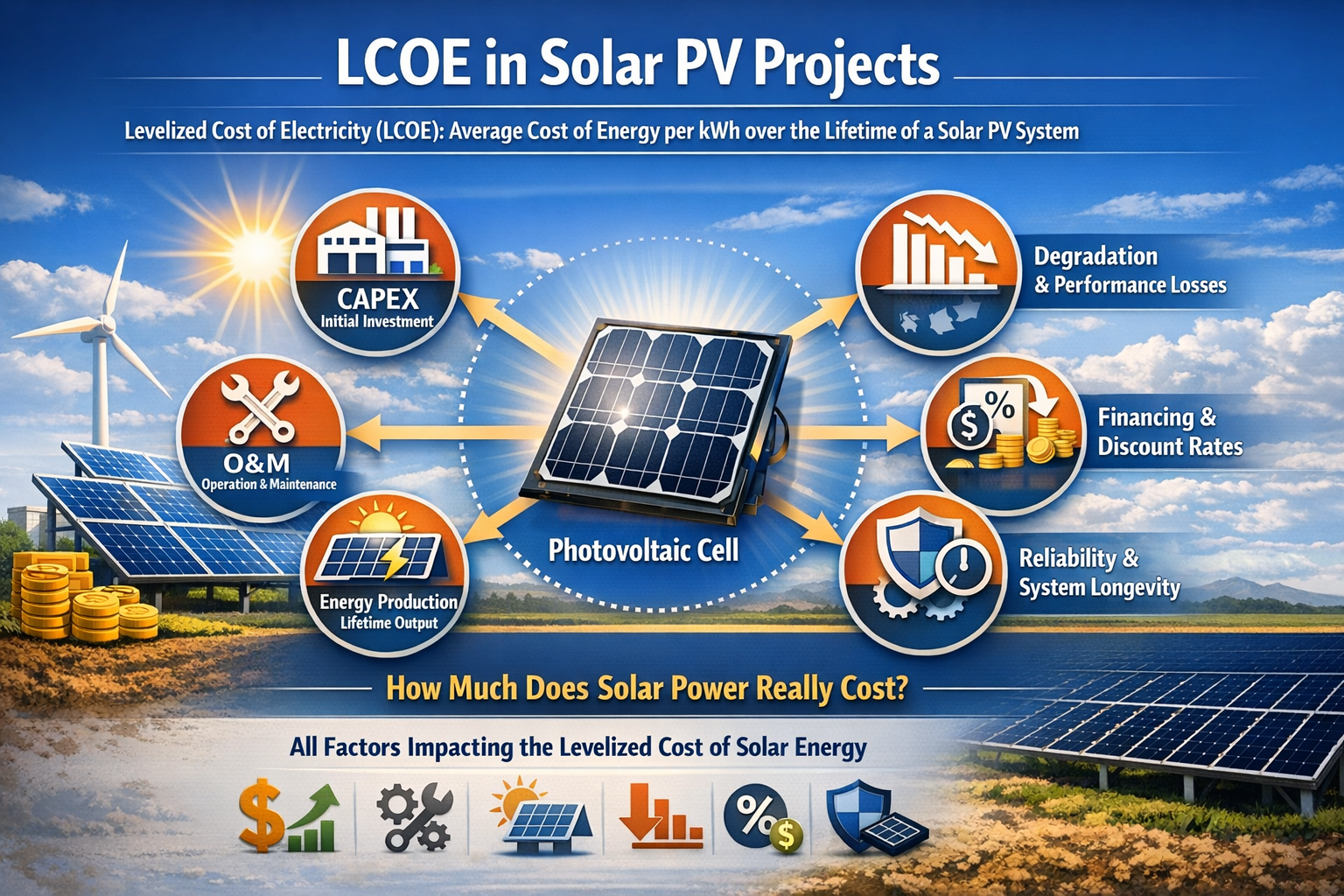
It is the average unit cost for the generation of one unit of electrical energy throughout the lifetime of a Solar PV. It comprises
Initial capital expenditure (CAPEX)
Cost of operation and maintenance (O&M)
Energy Production during the lifetime of the system
Degradation & performance losses
Financing and discount rates
Simply put, LCOE provides an answer to a critical question of how much each kilowatt-hour of solar power actually costs.
All elements that may have an impact on the cost of energy output, reliability, and life-cycle costs will have a direct effect on the levelized cost of solar energy being provided, and the photovoltaic cell is at the focal point of this issue.
Photovoltaic Cells: The Core of Solar Energy Generation
Photovoltaic cells are the fundamental units of solar panels. The material structure, efficiency, and lifespan of these cells determine the efficiency of solar power conversion.
Because the cost of energy production is in the denominator of the LCOE expression, a small improvement in the performance of cells can contribute favourably to the LCOE of solar PV technology. An increased production level for the same cost results in a lower cost per unit of product.
Efficiency of the Cell and LCOE
Higher efficiency, lower cost per unit
One of the most straightforward ways that solar cells affect LCOE is through conversion efficiency. Cells with high conversion efficiency produce more power per unit area, which results in:
Larger annual energy output
Uses less land
Decrease the costs associated with the balance
Better return on investment by increasing the energy output without a proportionate increase in the project cost, by using the efficient cell there will be a decrease in LCOE Solar PV.
Performance in the real world matters
The benefits of a high-efficiency solar PV are immense when considering laboratory efficiency figures, but the real-world performance under varying temperature, irradiance, and shading conditions has even more impact on LCOE for solar PV.
Cells designed for consistent output across diverse environments deliver superior lifetime energy production, further improving project economics.
Temperature Behaviour and Energy Yield
Solar cells function in outdoor environments where the temperature is usually well above that for standard test conditions. With an increase in temperature, most photovoltaic cells bear a voltage loss resulting in the reduced power output.
Cells with superior temperature coefficients lose less efficiency at high operating temperatures. This is particularly important in hot-climate regions, where thermal losses otherwise strongly increase the LCOE faced by solar plants.
Advanced cell designs that minimize temperature-related losses allow solar plants to maintain higher annual generation, directly lowering LCOE across the system's lifespan.
Degradation Rates and Long-Term Performance
Why Degradation Matters
All photovoltaic cells degrade over time, producing slightly less energy each year. However, the rate of degradation varies depending on cell technology, materials, and manufacturing quality.
Lower degradation rates result in:
Higher lifetime energy generation
More predictable performance
Reduced revenue uncertainty
From an LCOE perspective, cells with slower degradation ensure that the solar plant continues to deliver energy efficiently even after decades of operation, significantly reducing the LCOE Solar PV calculation over time.
Financial confidence for investors
Stable long-term performance also improves bankability. Investors favor solar projects where energy output projections remain reliable, reinforcing the importance of robust photovoltaic cell technology in controlling LCOE for solar PV projects.
Reliability, Failures, and Maintenance Costs
Reliability in a photovoltaic cell not only affects generation but also operational expenditure. Failures related to cells, such as microcracks, hotspots, or PID may lead to:
Reduced system output
Increased maintenance interventions
Module replacements and downtime
Higher maintenance means an increased numerator in the LCOE equation, which in turn pushes up the levelized cost of generation of solar energy.
The risks are reduced by having durable, high-quality cells that will keep operational costs down and preserve long-term economic efficiency.
Advances in Solar Technology at the Cell Level
Recent solar technology improvements have made the interaction of photovoltaic cells and LCOE much stronger. Innovations include:
Advanced mono-crystalline cell structures
Improved passivation techniques
Improved light absorption technologies
Smaller electrical resistance inside the cells.
These benefits enhance efficiency, decrease degradation, and build on the reliability that will help to decrease LCOE solar PV values.
The maturation path that cell technologies are following enables solar projects to obtain higher output with fewer modules, simplified systems design, and better cost optimization.
Cell Technology and Balance-of-System Cost Reduction
Photovoltaic cells also have an indirect effect on LCOE through their impact on balance-of-system costs. High-efficiency and high-power cells decrease the total number of modules required for a project. This, in turn, results in:
Fewer mounting structures
Reduced cabling and inverter costs
Reduced installation time
Simplified planning of maintenance
Savings in these costs further lead to reduced overall project expenditure, hence strengthening the economic case for advanced cell technologies in LCOE Solar PV optimization.
Energy Yield Predictability and LCOE Modeling
Accurate LCOE modeling depends on reliable energy yield forecasts. Photovoltaic cells with stable performance characteristics enhance forecasting accuracy and diminish financial risk.
Predictable generation profiles help project developers secure financing at better terms, which in turn indirectly lowers financing costs, another contributor to the LCOE solar metric.
To Wrap Up
Photovoltaic cells: These are more than mere subassemblies of a PV module, being the key factors defining the LCOE of a project.
Cell performance, from an issue of efficiency and temperature characteristics to the rate of degradation and reliability, is highly important to the outcome related to the solar PV technology referred to as LCOE solar PV.
To remain on track with the evolving solar sector, it is necessary to make further investments in the development of advanced cell materials as well as manufacturing.
With continuous advances in solar technology and a focus on performance-based design, solar photovoltaic cells are going to play a significant part in lowering LCOE for solar energy generation.
Through the integration of top-class photovoltaic cells into efficient modules, firms such as Emmvee are making a vital contribution towards the provision of affordable and efficient solar power solutions.